You have 0 items in your cart


 To read the original article, click here.
It’s not often that you find a single company embracing two apparently opposite approaches to product design. Göbel High-End first came to public attention through their innovative, wide-bandwidth, bending-wave driver, an iPad sized flat panel that covers the range from 170Hz to 31kHz, spawning a visually distinctive range of speakers, pairing it with narrow, multi-driver bass enclosures. Slim, silver and almost impossibly waisted, they did little to prepare the audio world for what was to come…
That was the Divin Majestic, a genuine monster of a loudspeaker, each one weighing 530kg, with a massive, angular and heavily tapered cabinet and a pair of 18” bass drivers in a three-way d’Appolito array. Throw in the sumptuous piano black finish and it was hard to believe the product had come from the same designer’s pen. If the Epoque Aeon speakers the company first launched where almost balletically slim and elegant, here was the dark matter iteration of the incredible hulk! But despite appearances, if you looked a little deeper, common themes started to emerge: the symmetrical driver layout; the angled, focussed baffles; the extreme attention to controlling mechanical vibration; an almost obsessive concern with system neutrality. This was the same expertise and similar technology, just applied in a different way. If those original Epoque Aeon loudspeakers approached wide-bandwidth audio reproduction from one direction, the Divin Majestics (and their smaller off-spring) approached the same goal from the opposite direction. If the Epoque Aeons were all about integration and the continuity that comes from what amounts to a single driver design, the Divins offered coherent energy, dynamics and speed – an alternative route to convincing musical reproduction.
The Majestic was followed by the Noblesse, the Marquis and now the Comtesse, each smaller and more compact than the last. But while the Noblesse scaled down the voluptuous, hourglass proportions of the Majestic, the Marquis established a very different aesthetic. Still deep enough to give cause for concern in smaller spaces, it essentially offered a shoe-box cabinet with a heavily facetted and sloped front-panel. Its reduced frontage makes for a visually ‘smaller’ speaker, but at 75cm deep, it’s one that still intrudes substantially into the room, even if you can place its vertical rear panel close to a wall. Everything is, as they say, relative.
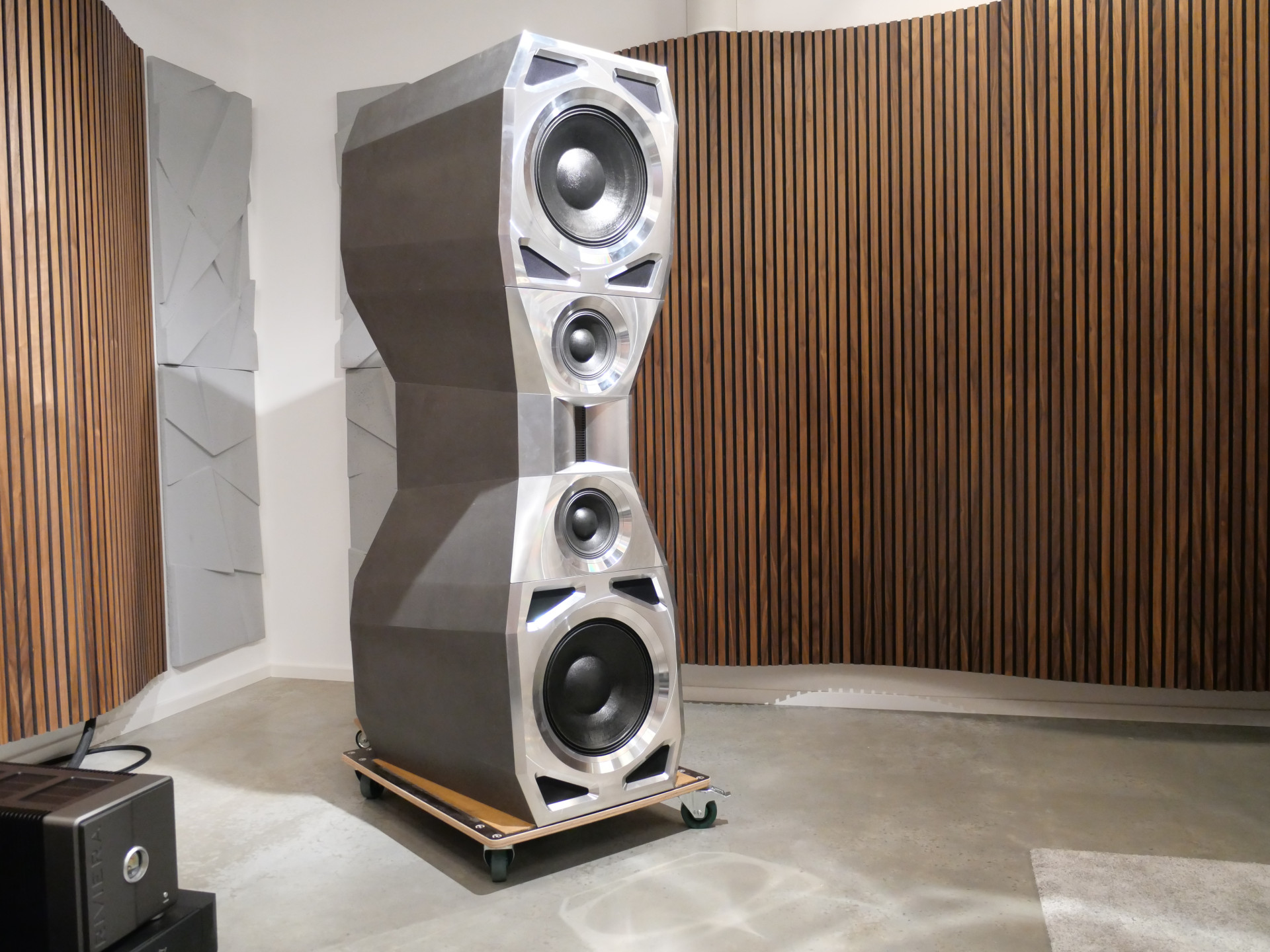
Which brings us to the Comptesse, a speaker that in many ways, presents more of a design challenge than any of the others in the Divin series. This is a genuinely compact floorstander. At 100 x 30.5 x 45cm, it has slightly less than half the footprint of the Marquis – and being 18cm (or over 6”) shorter, a significantly lower visual impact and physical presence. Those compact dimensions are reflected in the performance figures. The Marquis claims a bandwidth of 21Hz – 28kHz, ±3dB, with a nominal impedance of 4Ω (3.4Ω minimum) and a sensitivity of 92dB – making it one potent box! Compare that to the Comtesse and you find a bandwidth of 28Hz – 28kHz, and a drop in sensitivity to 89dB! With identical crossover frequencies and a slight (but arguably significant) drop in minimum impedance, to 3.3Ω, you’d be right to conclude that both speakers use the same midrange and tweeter, paired to a substantially re-engineered bottom-end, built around a long-throw 200mm/8” driver, as opposed to the 305mm/12” unit found in the Marquis. Faced with over twice the swept area and a considerably greater internal volume, it’s not exactly surprising that the Comtesse has to sacrifice 3dB in terms of sensitivity to achieve bottom-end extension that extends even as far as 28Hz. That leaves the Comtesse at some considerable disadvantage – at least on paper. Whereas the other Divin speakers can rely on dynamics and sheer bass-weight and scale to carry the day, the Comtesse is going to have to seduce rather than overpower its potential purchaser. Does it have enough of the necessary attributes? Is it dressed to impress?
Sit the Comtesse beside the Marquis and it’s remarkable that it generates the bass output that it does. It’s so much smaller, visually and physically, than the next model up, that there’s clearly something clever happening here. Like the other Divin speakers, that’s to do with the bass driver and its loading, but even in that context, the Comtesse is a little bit special. The 8” driver uses a composite paper/carbon cone, mated to a 2” voice coil and a motor system/suspension that’s capable of delivering a ±12mm excursion! That’s moving a lot of air: good when it’s going forwards, but a potential problem when it’s moving backwards. In order to handle all that energy and pressure, Göbel has built an incredibly rigid, complex, reflex loaded bass enclosure, incorporating a combination of parasitic and Helmholtz resonators to control and dissipate the considerable levels of unwanted mechanical energy. The driver is symmetrically loaded by a pair of ports, above and below it, to help prevent asymmetrical pressure within the enclosure exerting eccentric forces on the driver, a potential source of significant distortion. That porting isn’t as evenly disposed as the four ports that surround each driver in the Majestic, but with the symmetry of the cabinet, the top and bottom placing still improves significantly over the performance of a single, off-set port. The ports themselves are tuned to 34Hz, but even so, useful output still extends to the -3dB point at28Hz. More importantly, the careful control of the enclosed air volume helps prevent it slowing or interfering with the response of the bass driver, maintaining the speed and attack that characterises the Divin Series mid-band performance.
Talking of mid-band, the Comtesse sports the same 8”, glass-fibre reinforced paper cone, 2.5” voice coil driver seen in the Marquis and other Divin speakers. Again, this is a long-throw driver (at least for a midrange unit) with over 4mm of linear excursion. It uses a lightweight, glass-fibre bobbin and a mixed copper/aluminium voice coil, to keep the moving mass low. It is also heavily vented, to try and maximise thermal stability and limit compression under heavy load. It’s isolated in its own chamber, occupying roughly a quarter of the total cabinet volume. Above it sits the AMT treble driver, deep in its machined aluminium wave-guide and operating all the way up from 1600Hz.
So much for the drivers. The cabinet construction, materials, fit, finish and hardware on the Comtesse are exactly the same, or to the same standard, as on the other Divin speakers – with the considerable advantage of smaller panels adding even greater rigidity. The crossover is isolated in its own internal chamber. The rear panel is equipped with a quartet of the same WBT binding posts you find on the other Göbel speakers, meaning that the smallest model in the range offers the same option to bi-wire or bi-amp. The cabinet stands on a quartet of adjustable, ceramic coupled, stainless steel feet and, in a particularly useful option, Göbel offer a choice of tall or short posts for these, allowing additional tuning of the bottom-end balance to room size and placement. I used the taller feet/posts in the (smaller/narrower) Reading Room, the shorter ones in the main listening room, to good effect, demonstrating that these are more than just a nicety. Finish is the same, deep piano lacquer that graces the other models, available in black with soft-touch matt black aluminium parts and brushed silver highlights (other finishes are available, but may cost more). In fact, in every single way, the Comtesse is a Divin writ small.
When it comes to partnering electronics, I was able to run the Comtesse with CH Precision amplifiers (one or two A1.5s or M1.1s), the TEAD Linear B and the Trilogy 995R. Although the speed and transparency of the linear B and the solid musical enthusiasm of the Trilogy monos certainly had their appeal, the power of the M1.1 brought a special kind of authority and an emphatic dynamic grip to proceedings, especially when used to bi-amp the speakers (albeit at a considerable cost penalty over the alternatives). Looking at a more affordable, bi-amp option, I find the notion of four of Trilogy’s 994 mono-blocs an intriguing, if untested alternative. Göbel often use the (not dissimilar) hybrid, Class A Riviera amplifiers… And getting really basic, it would be interesting to try a pair of Neodio HQA power amps – at a combined cost that doesn’t hit five figures. The point is simple: the Comtesse might like power (but she doesn’t demand it); she’ll play nice with whatever you choose – just choose carefully. You’ll want an amp that can match the speaker’s in terms of musical integrity (rather than price) – an even sense of top-to-bottom balance being the key factor.
The Göbel speakers follow fast on the footsteps of the Stenheim A5-SX and Peak El Diablo, speakers that offer a fascinating contrast – and collectively, an interesting cross-section of available performance. In that company, the Comtesse is smaller, with considerably less low-frequency driver on show. Numbers don’t tell the whole story – not least because there are so many different ways to achieve them – but on paper the Göbel speaker appears to offer broadly equivalent bandwidth to the Stenheim, broadly equivalent sensitivity to the El Diablo. In practice it sounds quite different to both.
What the Divin Comtesse is, is fast. That’s not all it is, but it’s what the sum total of its considerable virtues adds up to. Amongst those virtues you’ll find focus, transparency, neutrality and an absence of additive colouration, sudden dynamic response, instrumental harmonics, bite and texture, structural clarity and an explicit sense of musical purpose and energy. This speaker will never leave you wondering. In many ways, its lack of boxy colouration and wide-open soundstage are more reminiscent of a really good electrostatic – but coupled to a greater sense of presence and instrumental substance.
Isabelle Faust is a violinist who let’s her instrument do the talking, a vessel for the concentrated energy and purpose in her performance. Even live, she never distracts from the music and plays with an intensity and focus that’s devoid of the showy or flamboyant. She also brings that talent to an extraordinary range of material, from Locatelli to Ligeti, composers that place dramatically different demands on a soloist. Those differences are, in part, summed up in the titles of two of her Harmonia Mundi recordings, il virtuoso, il poeta (Locatelli concerti, with Antonini and Il Giardino Armonica, HMM 902398) and the starkly explicit Ligeti Concertos (with François-Xavier Roth and les Siècles). The first binds the soloist in the formal structures of the baroque, with a rigid framework within which to display grace, fluid continuity and purposeful rhythmic insistence. It’s a field of subtlety and nuance, counterpoint and formal, almost mannered exchange. It’s a world that Faust embraces fully and generously, leaving space for others amidst an equality of exchange. It brings depth and vitality to the small group performance as a whole, rather than spotlighting the soloist – while at the same time releasing the leader to lead with brilliance.
What a contrast to the angular, disjointed and almost abstract structures and sharp dynamic and tonal contrasts of the Ligeti – all sudden interjections, bold and intense against the complex, freeform layers and space of the orchestral backing. This is difficult, clashing, often atonal and yet exhilarating music – at least it is on the Göbels. The Comtesse manages to master not only the brilliance of Faust’s playing against the formal structures of the Locatelli, but brings rhythmic rigour and precision to bind the disparate elements that explode (or maybe implode?) into the Ligeti. At the same time, there’s the contrast with the sparsely meandering beauty of the Cello opening to the second section (there are seven in all), the gorgeous duet that develops with the violin, before the angular attack and skittering, pizzicato passages bring back the startling and arresting quality that underpins the sheer intensity in the piece. The speakers have an uncanny ability to track both the structural and the dynamic demands in the performance, to work within the strictures of the Locatelli and also respond to the constantly shifting demands of the Ligeti, without stifling the former or losing the overall shape of and their grip on the latter. As an example of responsive, surefooted articulation it’s impressive: as impressive in its expressive range as Faust’s playing – which is surely the point.
In many ways, the examples above represent opposite extremes, musically, tonally and in presentational terms. But they also demonstrate the Göbels’ versatility and ability to stand behind the performance rather than between that performance and the listener. They explain not just what the speakers do but how they do it. Move to the centre ground and if the virtues are less obvious, the musical benefits become clearer still. Play Neil Young’s live album Massey Hall 1971 (Reprise PS 03) and from the explosive opening applause and the expansive acoustic to the weight, attack and precise pitch and spacing of the guitar notes and Young’s characteristic and oh so distinctively nasal voice, the immediacy, atmosphere and presence in the performance is as convincing as it is compelling. The space reaches forward to embrace the listener, Young is seated right there, the interlocking vocal and guitar lines, accents and emphasis drive home the songs, underpinning this heartfelt performance, its quiet intensity and intimacy – just as the contemporary headline writers had it. They were there and, after listening to the album on the Comtesse, you feel like you were, too. The transition from guitar to piano is seamless, the hesitations and spoken interjections between the tracks just add to the feeling of continuity and ‘being there’.
That speed, surefooted timing, pitch and spacing of notes extends down into the speaker’s bottom end, where bass instruments have a real sense of texture and character, attack and decay. It’s a world away from the tuneless thud that emanates from so many speakers trying to eek a bit more weight and impact from their bottom end (and, ironically, achieving one at the expense of the other). Play the Barbirolli/Hallé recording of Sibelius’s Second Symphony (HMV ASD 2308) and the extended pizzicato passage that opens the second movement is beautifully paced and motive, moving through the melodic rises and falls, the passing of the theme from basses to cellos – which so often goes unremarked – unusually clear and explicit, both spatially and in terms of instrumental weight and character, the subtle increase in attack to the notes. The timp rolls are especially impressive, with a natural texture and clarity that gives not just the sense of the skins, but of the rapid, individual strikes, rather than being just a smudge of low frequency energy. The speed of response necessary to capture these textural nuances and tiny shifts in level speaks volumes about both the low mass of the driver, the power of its motor and the controlled behaviour of its cone. This lack of sonic and musical inertia, perhaps more than anything else, is what makes the sound of the Comtesse so reminiscent of what people crave from electrostatic speakers – but what those speakers so seldom deliver. What the Comtesse demonstrates so unequivocally, is just how much performance you can get from a suitably sophisticated paper cone – even if many designers don’t.
The second thing the Comtesse is, is seamless. Just as the speaker’s bottom-end has an almost midrange-like clarity, agility and articulation, that speed of response and even projection of energy extends right across the speaker’s range. You hear it in the stability of the soundstage and the consistency of instrumental position and dimensionality, irrespective of pitch or level. Even the extreme intensity of the Ligeti doesn’t provoke a wander or shimmer in the players’ positions or the overall acoustic. Piano is especially notable for the step-less continuity in extended runs, in the clarity of the left-hand/right-hand relationship. Play Maria João Pires seminal Denon discs of the Mozart Piano Sonatas (OQ-7214-21-N) and the Göbel’s capture the delicacy, crystalline precision and clarity of line perfectly. The fluid grace and perfect pace and weighting of the notes that make these such captivating performances is as unforced as it is undisturbed by discontinuities or bumps in the reproductive process. The instrument is utterly stable, Pires’ input wonderfully nuanced and confident.
That dynamic response, integration, linearity, the coherence of the energy envelope and its ability to project an even sense of substance, irrespective of frequency is what gives the Divin Comtesse its invisibility. It’s also what makes it sound more like a single driver than a multi-way system. A big part of that quality is derived directly from the deft, tactile and pitch/texture definite bottom-end. The Comtesse doesn’t have the weight or the scale that speakers like the Stenheim A5-SX or Peak El Diablo deliver, but nor does it lack for musical (as opposed to physical) impact. Examples are legion, from the explosive snap of the percussion on the Ligeti, to the swelling energy of the enthusiastic claps at Massey Hall. These speakers are not about rattling rib cages. They’re about clarity, musical insight, immediacy and connection. They may not pin you to the chair with shifts in musical density, but they’ll let you hear (and almost count) exactly which instruments have joined the party. They will appeal to the listener who wants to hear into the performance rather than sit outside it, who values information over impression, who wants to appreciate the individual, both as a performer and as a contributor to the whole. The Stenheims deliver more drama, the Peaks more scale and power, but neither gets you closer to the musician(s) than the Göbels.
And the third thing that the Comtesse is, is distinctive. This speaker doesn’t sound like other boxes this size. In fact, it pretty much doesn’t sound like other boxes, period. It has a unique blend of virtues, that mean it can offer a different perspective on the music and different options within a system.
You’ve got to be careful suggesting that a box speaker has electrostatic tendencies – which is why I’ve been at pains to qualify which exact qualities that refers to: the speed of response, the seamless continuity, the evenness of character and output. But where the Comtesse majors on the clarity and transparency that many electrostatics have, it doesn’t come at the cost of thinness or an insubstantial sense of presence and body. The Göbel’s sense of musical purpose is distinctly box-like – even if its colouration levels are not. Meanwhile, I’m going to make another, perhaps equally easily misunderstood observation: The Divin Comtesse is the perfect partner for a really good sub-woofer.
Now, please note: I didn’t say it needs a good sub. The bottom-end goes deep enough and is certainly informative enough to satisfy on a musical level. What it isn’t, is visceral. Göbel offer bigger speakers to tick that box, as well as their own sub-woofers. But the Comtesse offers a fascinating and unusual combination of physical and musical virtues that make it peculiarly suited to pairing with a set of serious subs.
The first and most obvious of these characteristics is size. The Comtesse is an extremely compact speaker whose beautifully balanced bottom-end means that it will work in smaller spaces.
The second is its sheer quality. The Comtesse shares its construction and the drivers that generate the vast majority of the musical range with the other Divin speakers – essentially the same high and mid-frequency drivers as the massive Majestic and slightly less massive Noblesse. Göbel has leant more than a little about working with those drivers and mating them – and it shows.
Thirdly – and perhaps most importantly of all – is the speakers’ low-frequency linearity. As I’ve already suggested many speakers, especially smaller speakers (of which this is one) tailor their bottom-end output to augment the sense of musical foundation, scale and weight. That makes mating them to a sub-woofer a far more challenging proposition, especially if you want to run the main speakers full-range, in order to avoid an additional high-pass filter in line with the mid-band (and the rest of the range).
By avoiding the temptation to juice the bottom-end of the Comtesse, Göbel has created one of the most directly insightful loudspeakers I’ve lived with. At the same time it has also, by default, made a speaker that works wonderfully well with high-quality sub-woofers. It’s no coincidence that when the company first launched the speakers in Munich last year, they did so in a system that also employed a pair of Sovereign sub-woofers. With the Comtesse installed in the main Music Room, the temptation to run them with the PureLow GR subs was just too great to resist – as were the results. Detailed discussion of that set-up is outside the scope of this review and will wait for the arrival of the Sovereign subs from Göbel, which is already planned. But it is certainly worth noting that this is a trick the Comtesse can turn. An impressive performer as a standalone speaker, it’s also a perfect partner in a four-box set-up if you need to generate scale and full-range reproduction in a smaller space, or one that demands a more discrete solution.
The Divin Comtesse is as fascinating, different and distinctive as it is immune to the clichéd tropes of audio reviewing. It doesn’t tread the familiar path of trying to sound bigger than it is. It doesn’t sweeten the musical message with the rounding, smudging effects of intermodulation distortion and stored energy. It doesn’t rely on some, single, stand-out feature or attribute to gain short term attention (at the cost of long-term frustration). Instead, it depends on being correct: correct in the sense of manners and behaviour, as well as in terms of presentational or spectral liberties. The phrase, “A place for everything and everything in its place” might have been coined to describe the Comtesse. It reflects the speakers’ inherent sense of musical balance, perspective and temporal accuracy. But it doesn’t reflect just how deep a musical insight they can provide.
Like the other Divin speakers, the Comtesse are as demanding of speaker and system set-up as they are exacting in terms of musical balance. Toe-in, attitude, height (both off the floor and in space) and listening distance/location in the room must all be spot-on if you are going to realise their considerable musical potential. Just as they reflect the care and attention you put into their set-up, they’ll also reveal any leanings or liberties in your partnering equipment – both the strengths and any shortcomings. Fortunately, their sheer clarity and transparency is itself a considerable aid when it comes to hearing just what’s going on. Indeed, hearing just what’s going on is what these speakers are all about. Some speakers are like a time-machine, that at their best can shift you almost bodily to the original event. Others are like an electron microscope, that lay the recording out, like a slide for study. The Gobel Divin Comtesse is something else entirely. It offers that close up detail and separation, dynamic discrimination and sense of internal structure, but it offers life and dynamism too.
In terms of sheer access to the musical event (and the recording that captured it) I’m not aware of another speaker at this price (or prices quite a bit higher) to match what Göbel has achieved here. It’s a hell of basis around which to build a system.