You have 0 items in your cart


To read the original article click here.
King hereafter?
By Roy Gregory
As a product, as a theoretical construct, the high-end loudspeaker is a whole bundle of contradictions. It employs the oldest and most established technologies in electronics and audio, mature theories that should make the design task easier. But it also embodies directly conflicting mechanical requirements that make it arguably the most compromised of all audio components. It has to move, but it also has to remain still. It has to make noise but also be quiet. It is the nexus where physics and mechanics, acoustical and electrical theory collide. These conflicts make designing a genuinely high performance loudspeaker no easy task, one that involves balancing the inevitable compromises and, sadly all too seldom, clever solutions.
It helps explain why there are so many different approaches to building high-end loudspeakers and why, amongst all audio products, loudspeakers have the longest shelf-life – almost regardless of their inherent flaws. If a speaker can do just one thing and do it well, it will find an audience. Back that strength up with a few other attributes and/or a good story and you’ve got it made. If designing loudspeakers is all about compromises, the end results all too often reflect that all too clearly.
In one sense, loudspeakers are the physical embodiment of that old saw, “The thing that made Pink Floyd unusual is that they had two good ideas: most rock bands exist on only one.” When it comes to loudspeakers, new thinking and new approaches are few and far between, often implemented at the expense of other important considerations. Few companies manage a truly rounded and all-embracing approach to the issue of loudspeaker design – but one that does is Göbel High-End. For Göbel, it’s all about controlled resonance, as a brief look at their design trajectory will attest.
Start as you mean to go on…
The company’s first products were based around an innovative, wide-bandwidth, bending wave drive-unit. A flat diaphragm, roughly the size and shape of the original iPad, it was capable of operating from 170Hz to 31kHz, a range demanding a sophisticated understanding and control of the driver’s resonant behaviour, achieved through the innovative combination of materials and coatings. Combined with multiple, conventional bass drivers, it produced a family of slim, elegant and remarkably musically coherent loudspeakers that remain in production today, although the company’s focus has largely shifted to the ostensibly more conventional Divin series. I say “ostensibly” because, despite the use of multiple moving-coil drivers and ported enclosures, there’s very little that might be described as conventional about the Divins…
For starters, they’re big. Even a physically compact Divin speaker, like the Comtesse https://gy8.eu/review/gobel-divin-comtesse-loudspeaker/ is astonishingly heavy and employs a way bigger than average 8” midrange driver. Even in these days of larger midrange diaphragms, that’s unusual and represents a 30% increase in swept area of a 7” unit, almost twice the swept area of a 6” driver. Their cabinets are heavily angled and facetted and, as they get bigger, employ fully symmetrical driver arrays. Those two aspects of the designs are revealing. On the one hand, if the bending wave-based Epoch Aeon speakers had an Achilles’ heel, it was a lack of dynamic range – hence the Divin’s large diameter drivers (and the sensitivity that goes with them). But if you are going to avoid throwing the musical baby out with the sonic bath water, you’d better maintain musical coherence and control the resonant behaviour of the big boxes that inevitably result. Like I said, for Göbel it’s all about controlling resonance – whether you are generating or dissipating it.
Let’s start with those drivers…
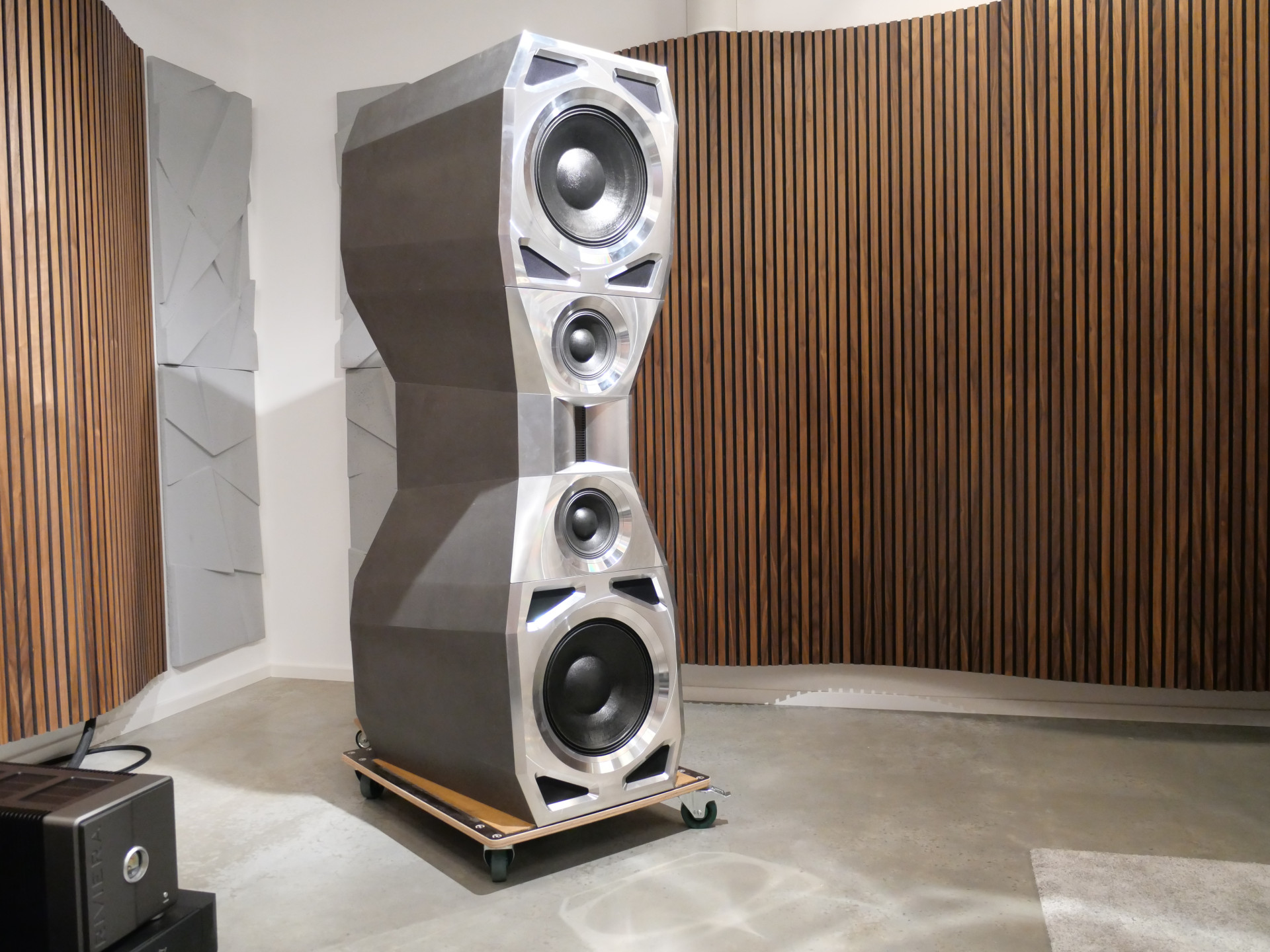
Take one look at a pair of Divin Monarques and it’s hard not to be impressed by their sheer size. These speakers are huge – and dominating their appearance is the symmetrical array of large diameter drivers flanking the centrally mounted, AMT treble driver with its substantial aluminium wave-guide. They’re big and (in this instance) trimmed with real gold leaf. If that’s a little ostentatious for you, you can have (silver coloured) platinum leaf or soft-touch black paint. Whilst gold isn’t normally my thing, here it works, partly because it helps to break up what would otherwise be a massive, looming, black presence, partly because it tones with the champagne (sauternes?) finish on the M10s. You pays your money and takes your choice, but I’m reasonably confident that the driver trim can, just like the colour of the genuine polyurethane piano lacquer on the cabinets, be adjusted to order.
While the drivers might seem like both the most obvious and conventional thing about what is an ‘unusual’ looking loudspeaker, look more closely and you’ll realise that they are anything but run-of-the-mill. Purpose built with electrical and mechanical characteristics to suit each speaker design, the reinforced pulp cones (carbon fibres for the 15” bass units, glass fibres for the midrange) are heavily treated with unique, specially developed and frequency specific coatings, a direct result of those evolved for the bending wave driver and essential to control the resonant behaviour and audible signature of such large cones. The cones are terminated with pleated fabric surrounds, to avoid the damping and subsequent loss of energy associated with rubber surrounds. They’re built onto large-diameter, double-sided voice coils, driven by powerful neodymium magnets, an arrangement that is both efficient and allows for massive venting and thus thermal stability, avoiding the often-underestimated impact of thermal compression, especially when handling the serial, large excursion demands of repeated orchestral tuttis or synth/bass lines. These bass cones don’t flap or wallow around the way most 15” drivers do. In fact, watch and you’ll barely see them move – although more on that later.
The 8” midrange unit operates from 120Hz to 1600Hz and, together with the AMT driver is common to all of the Divin speakers. The only difference is the size of the AMT’s radiating area and matching wave-guide, which is increased to match the twin midrange drivers in the Noblesse, Monarque and Majestic. The AMT driver is sourced from Mundorf and is heavily modified with a new rear chamber and horn flare to optimise its frequency response and dispersion.
’ll get to the cross-over in a while, but it’s appropriate to look at the system characteristics here. Together, the five drivers, with their combination of efficiency and large swept area, deliver both bandwidth and dynamic range. Göbel quote figures of 96dB sensitivity and 21Hz to 24kHz for the Monarque. They also quote an amplifier friendly 4Ω load, with a non-reactive nature and a minimum of 3.2Ω. That should make the Monarque both responsive to input and encouraging for the driving electronics, important considerations when it comes to system performance, considerations that are seldom addressed by the silo-like approach of too many speaker designers.
What’s in the box…
So much for the bits that move: what about the bits that are intended to stay still? Did I say that they’re big? Fully 194cm tall, 54cm wide at the front, 68cm wide at the back and 84cm deep: that’s 6’5” tall, by 21.6”/27” wide, by almost 3’ deep! That’s definitely big. With an all-up weight of 380kg each (an elevator worrying weight of almost 850lbs) it would be easy to assume that Göbel has taken the time-honoured (but largely ineffective) high-mass approach to cabinet design. But the sad fact is that it’s almost impossible to build enough mass into a (remotely portable) speaker to dissipate the considerable internal energy that even a system of modest bandwidth generates. 21Hz and 96dB: forget about that! In this case the high mass isn’t an end in itself, but an end result of the construction and materials involved. It’s also only half the story. A loudspeaker cabinet isn’t just the box itself, but the air mass it contains and both need to be controlled.
Let’s start on the outside, with the Monarque’s striking shape. Although the hourglass profile and the reasoning behind it are shared with the Noblesse and Majestic, the new model is, to my eyes at least, the most attractive and physically balanced of the three, with an almost sculptural quality to its appearance and proportions. Like the Noblesse, the cabinet is a single, monolithic construction. Like the Majestic, it mixes materials, with CNC-machined aluminium baffle plates joined to a laminated, multi-layer, melamine-based carcass. The constrained-layer panels absorb and dissipate energy, but also concentrate it in specific frequency bands, making it easier to deal with. Their shape also eliminates parallel edges and internal standing waves, at least for the most part: it’s hard to totally eliminate parallel edges on the baffle and rear panels, without resorting to Geary-esque extremes! But by varying the size and shape of the panels, their resonant behaviour can be controlled, predicted and strategic bracing can do (most of) the rest. To that end, the cabinet walls reach a maximum combined thickness of 105mm/4”. The result is a remarkably rigid and well-behaved enclosure that adds little of itself to the performance and is even less noticeable. So much so that, listen with your eyes shut and it’s a surprise to be confronted by such large speakers when you open them.
Those strikingly angled panels with their heavily bevelled edges reveal the internal construction, with six separate enclosures, one for each driver and the crossover. The tapered walls and sloping internal baffles create chambers without parallel surfaces to help eliminate standing waves. The internal air mass in each chamber is further controlled by targeted application of Helmholtz resonators and rigid, ceramic foam that dampens velocity without absorbing energy. That energy, properly deployed is crucial to the speaker’s output and dynamic response.
The Divin speakers all employ symmetrical porting. In the larger systems, that takes the form of four carefully shaped ports arranged around each bas driver. It’s an unusual arrangement that ensures symmetrical behaviour within the enclosed air-mass and equally distributed forces on the driver diaphragm. Single, large, off-set ports tend to allow the resonant energy generated by the standing waves that exist in the air-mass within a conventional enclosure to escape, producing audible distortion. Many designers handle this problem by placing them on the rear-baffle, creating a delay between the distortion and the impulse that generated it, minimising its distracting influence, if not its effect. But that’s a kludge, at best, and ignores a secondary and in many ways far more significant issue. An off-centre port will also generate an uneven resonance within the enclosed air-mass, which in turn acts to de-centre the driver, producing a significant increase in noise and distortion. Göbels symmetrical front porting promises not only lower distortion, more pistonic output from their bass drivers, but maximises both the musical energy generated and its integration into the output of the system as a whole.
Stitch that!
Holding the whole, massive edifice together, is the crossover and I’ve left it until last for a reason. As I’ve already described, it’s housed in its own, separate chamber, located behind a machined and profiled aluminium baffle. Within the enclosure, each leg of the point-to-point wired network is individually potted and isolated on vibration mounts, while the components employed read like a guest list of the great and the good when it comes to specialist audio parts: Just as you’d expect. But littering your network with audiophile fairy-dust does little to guarantee magical performance. It ain’t what you use, it’s the way that you use it – that’s what gets results. It’s also what makes the Monarque more than a little special. If most of what I’ve described so far is common to the other Göbel Divin designs, the cross-over isn’t. The Monarque delivers a significant step up in overall dynamic and musical coherence when compared to its siblings – and that’s down to refinements in the crossover topology and componentry.
The company has invested a huge amount of time and effort into refining the slopes and phase characteristics of the crossover, improving performance inside the pass-band and out of band too. Together with a complete reappraisal of component sources and types, especially in critical locations, the result has been that step up in integration and temporal, spatial and dynamic coherence. The earlier Divins were always seamless for such large boxes, large drivers and wide bandwidths. The Monarque takes that to a whole new level. I guess you don’t know what you don’t have until it comes along…
The significant improvements in musical communication, intelligibility and the more natural perspective that goes with them is obviously good news, but it gets better: those benefits will soon be available to owners of the earlier models. It will be a factory/distributor upgrade and (following the lead established by CH Precision) the upgrade will cost the difference between the old model and the new. Having heard what the new crossover does for the Monarque, if I was an existing Divin owner I wouldn’t be forming an orderly line outside my supplier’s premises, I’d be beating on the door…
Bits and bobs…
I’ve already spent considerable time describing the arrival, installation and set-up of both the Monarques and the system driving them. You can wallow in that here https://gy8.eu/blog/and-so-it-begins-again/ .But a couple of points bear repeating. The first concerns the fact that the speakers are bi-wireable and, like all the Divins, respond positively to both that and bi-amping – although if you go the four channel route, you’ll need four identical channels, not just similar ones. Try to mix and match amplification, even within a single manufacturer’s line and you’ll damage the musical coherence that makes this speaker so special. I ran the Monarques with CH Precision M10s and M1.1s as well as Trilogy 994 mono-blocs – all with conspicuous success. I also used two-channel variations on the above, as well as Trilogy’s 995Rs and the VTL S400-II. In all cases, as good as the two-channel option was, four identical channels absolutely walloped it, in terms of not just scale and dynamic range, but dynamic response, immediacy and musical presence. If you are seriously contemplating the Monarques and you are running two channels of amplification, budget to add another two in the not too distant future. Or better, right now!
Secondly, I’d like to draw attention to the Göbel flight-cases, a transport and installation solution that should be the benchmark for all such speakers. Not only do they provide the necessary protection for the speakers (I’ve never received a damaged speaker or flight-case from Göbel) but the simple expedient of using three-part construction with a separate base makes handling and installing even the heaviest speakers safe and secure. Having been confronted so often with the problems of trying to extract heavy speakers from two-part flight-case or poorly designed crates, my (ever fragile) patience is wearing increasingly thin. Other manufacturers should look at the Göbel solution and learn from it. From a customer’s perspective, it’s yet another reason to congratulate yourself on your purchase, as the installation team position your new ‘babies’ quickly and with a minimum of drama.
Finally, I’d like to mention the feet that Göbel fit to their speakers. These perform the dual functions of providing a mechanical ground for the cabinet and the precise attitude adjustment that’s so vital to extracting the maximum performance from any loudspeaker. Their high-quality stainless-steel and ceramic construction, large area footprint and 35mm fine-pitch threads are a joy to work with, as practical as they are effective. They’re such a contrast to the nasty, soft metal spikes supplied with most (even seriously expensive) speakers. You know, the ones that are almost impossibly notchy to adjust on their course-pitch threads and whose tips go blunt or fold over as soon as they contact a hard surface. The fact that Göbel also supply up-stands/central posts for their feet in three different heights as standard (12mm, 32mm and 52mm) is further proof of how much thought they’ve put into the problem of actually delivering the performance they promise in the customer’s home.
But what does it all mean?
While some of these design elements can be seen in other speakers, some are genuinely unique. But what’s even more unusual is to find all of these elements combined in a single speaker design. If Göbel’s design credo is “Leave no stone unturned”, the Monarque and their other speakers make a convincing case for both their diligence and its effectiveness. As much as the details make for a great story, it’s the musical performance, the musical performances that these speakers deliver that justify their cost.
I’ve expended considerable time and effort on these speakers already, with an introductory piece and two long articles dedicated to describing the set -up and installation of both the speakers and the system driving them – not to mention the physical effort of dealing with so much stupidly heavy equipment! Only an exceptional result would justify all that oxygen. I’ve already (strongly) suggested that the Monarques are indeed something special. It’s time to go further than that. Göbel’s new ‘flagship-lite’ loudspeaker sets an important new benchmark for performance at a key price level. It could (and should) be a game-changer, not just at its elevated cost, but further down the company’s range too. Such a statement demands justification – and now, finally, is the time for that.
When we talk or think about a system or product improvement, we tend to expect or express it in terms of sonic ‘mores’: more bass, more width, more depth, more detail, more dynamic(s)… It’s especially true of speakers, where the name of the game, whether you are a customer or a manufacturer, is to get more out of a given package. The bigger the box the truer that is.
It’s easy to understand why.
Not only are these quantitative differences easily heard or demonstrated on an immediate basis, they play into our comparative model of product assessment. Even more importantly, in an activity where we spend so much of our time battling uncertainty, such emphatic changes are a welcome relief. What’s more, invest in a large loudspeaker and it’s reassuring to hear a large sound. With buyer’s remorse and inter-web trolls lurking just over your left shoulder, bigger is definitely better when it comes to that sound. Except that, more often than not, it isn’t…
Take a successful, balanced speaker and extract more bass, or more dynamics and ‘slam’ and those changes will come at a cost. That cost might be in terms of drive characteristics or integration, musical coherence or overall balance, but wherever you are expected to pay, you can assume the price will be high. Taking an existing performance envelope and trying to stretch or extend it, often in a single direction, rarely ends well. Yet it’s a popular developmental path, if only because its easy to do and to demonstrate/hear. I think of this pursuit of sonic extension as an outward looking attitude and its almost universally prevalent. You can lean a speaker’s performance towards the impressive (at the expense of integration and musical integrity) and all too often that’s exactly what happens. It’s part design and it’s part set-up, but it’s increasingly common at shows, a tendency led by the larger and more respected brands that should know better.
Now let’s look at the Divin Monarque. The core elements and construction are predetermined by the previous models. So, once the performance envelope has been defined by the physical elements – a cabinet and drivers large enough and powerful enough to deliver 96dB sensitivity and extension to 21Hz – the focus switches inwards, maximising the performance within that envelope. Of course, a big part of the design process is balancing those characteristics. 96db is plenty sensitive, especially for a conventional, reflex loaded cabinet. It demands some pretty special drivers with exceptionally powerful motors. It also demands a large enclosed volume. The Monarques are certainly big and, given their size, extension to 21Hz (±3dB) is less than might be expected – at least, until you take that high sensitivity into account. At which point the speaker’s balance of virtues is thrown into stark relief. This speaker’s musical goals are as distinctive as its looks. Yes, you can take it and bend the performance out of shape, aiming for the huge and spectacular to match its size and appearance, but to do so is to severely limit their potential. This speaker is all about balance and in that regard, it knows little or no competition.
Like I said earlier, I’ve spent a lot of time discussing both the system driving the Monarques and its overall set-up. Throughout those articles, the equipment selected and the process itself, the single guiding principle has been consistency. Whether you are talking cables, supports, grounding or electronics, the level of continuity achieved is exceptional and far from the rule. It wasn’t easy to achieve, but the results are more than worthwhile, reflected in an astonishing level of musical coherence – and nowhere is this more apparent than in the musical delivery of the speakers.
A whole that thrives on the sum of its parts…
If I had to sum up the Monarque in a single phrase, I’d describe it as, “a musically balanced, 3D performer.” Although, having said that, I suspect that most readers would misunderstand or misinterpret the intent in that statement. Break it down and it consists of three separate characteristics, each defined from a musical perspective:
Balanced – implying that all of its qualities are present to an equal degree. That’s easily understood but its implications are less so.
Which brings me to “3D”: a term normally used to refer to width, depth or height, collectively, physical dimensionality: that isn’t the sense here. We’re talking the musical rather than the physical realm. In this instance the three dimensions are temporal, spatial and dynamic – and that’s a whole different world with its own, distinct rules.
Finally, there’s that word “performer”, a term chosen specifically to embrace the sense of musical performance and, in turn, expressive range.
Now look again at that description and what it suggests about the Divin Monarque. Here you have a speaker where its ability to portray music in a spatially, rhythmically and dynamically balanced way heightens its musical and expressive capabilities. That ability is directly attributable to the speaker’s design choices and execution and is reflected in its unusual specs – not that they tell the whole story.
Stand in front of the Monarque, take in its imposing dimensions and then, look at the specs on paper. You might be disappointed by the quoted low-frequency bandwidth. Don’t be! By opting for a higher-than-normal sensitivity and massive swept area, rather than squeezing the last few Hz of low-frequency extension out of the system, Oliver Göbel has opted to create a system capable of delivering musical energy with equal attack and dynamic range, right across its useable output. He’s further doubled down on that by creating a crossover with non-reactive electrical characteristics, which make the most of the driving amplifier, taking that further still by offering and encouraging the adoption of bi-amped operation. The result is a more informative, more natural bottom end, with greater musical power and impact than those numbers might suggest – or speakers with more impressive numbers actually deliver. This is real bass in real time.
Everything in its place…
The curved, symmetrical driver array delivers time and phase coherent output, while the fixed relationship between the drivers allows both acoustical coherence and incredibly accurate pair matching. The output of each completed system is fine-tuned in an in-house anechoic chamber that’s 6m on a side, allowing accurate and repeatable measurement down to 80Hz. On top of which, the company has unlimited access to an even larger chamber, for product development purposes. When you are pair matching to within ±0.2dB, it’s essential to have fixed relationships between the drivers. In itself, that’s incredibly impressive, given the assumptions that underpin stereo reproduction, but it also gives the lie to the configurable/adjustable approach that’s adopted by other manufacturers. If the physical relationship between the various drivers in a system is almost infinitely variable, while there’s a single perfect setting to fix their output correctly, there’s an infinite number of settings that will be just plain wrong. How do your do like those odds?
More importantly, by affording the temporal, spatial and dynamic domains equal priority, the Monarque is able to present natural scale, perspective and proportions, dimensionally and musically. Rather than the stereo image being an end in itself, it’s simply a natural adjunct of things being the right size and in the right place at the right time. It’s all about that obsessive approach to cabinet design and the controlled dispersion of energy within the structure and the enclosed air-mass, eliminating resonant peaks and stored energy that disturb, exaggerate or blur the speaker’s output. The musical content, pattern and energy in the signal are preserved intact and in proportion, reproduced with a natural sense and flow that is as unimpeded as it is expressive. It offers the opportunity to make the speaker and the system driving it essentially invisible, at least in musical terms – even if, physically, the Monarques are hard to ignore.
How does this impact musical reproduction and presentation? Given the ‘dimensions’ in question, the place to start is with an acoustic recording of piano. It’s an obvious choice, given the instrument’s bandwidth, complexity, potential power and percussive nature – with the emphasis that places on the placement and spacing of notes. One recording that has graced every system that’s played in the Music Room in the last five-years is Víkingur Ólafsson’s Debussy-Rameau (DGG 4837701) and it has become its own benchmark, not so much for the quality of the recording – which is excellent by modern mainstream classical standards – but for the quality of the performance. Playing it on this speaker, on this system, the fluidity and pacing are as natural as they are unforced. Whether it’s the cascade of notes from Rameau, or the studied, reflective space of Debussy, the speaker puts the music firmly first, grasping and holding the attention, anchoring it on a solid, dimensional and beautifully scaled instrument, redolent with harmonic and mechanical complexity.
A place for everything.
The musical connection and articulation of left and right hands is uncannily human. So often presented as almost separate entities on separate instruments, it’s one of the things I look for first with this recording and during set-up. Here, the continuity across the keyboard is utterly contiguous, the expressive quality across the two hands a single extension of a singular emotional and musical vision. That holistic, expressive range is a key quality in successfully reproducing this recording and performance, in all its aspects. I’m used to it being good – just not this good. The ability to capture the relative position and power, the energy and harmonic structure of a note with equal clarity and accuracy, irrespective of frequency, elevates the presentation to a level that I’ve only heard rivalled by the active Avantgarde Trio G3, with its sudden response to dynamic demands able to accurately mirror the action of the instrument, the weight and attack of each note. The Monarque can’t match that degree of immediacy, explicit separation and dynamic discrimination, but it comes awfully close, with a slightly more distant perspective that captures the second half of notes, the layers and duration of their tails, more naturally. The instrument sounds bigger, richer and more planted as a result, with a more developed and encompassing acoustic. With the Trio, Ólafsson and his instrument are here. With the Monarque, you are there. It’s an important presentational distinction and one that contributes directly to the Monarque’s ability as an all-round musical performer.
Increase the human complexity, if not the instrumental scale and the Monarque’s ability to capture the natural balance of instrumental forces, the placement, relative energy and most importantly of all, the human interaction and agency behind the performance comes to the fore. Play the Second Movement of Beethoven’s String Quartet No.7, Op.59 – Allegretto vivace e sempre scherzando (Chiaroscuro Quartet, BIS-2688) and the poised precision in the playing, the shifts in bow pressure and the dramatic shifts in level and musical density certainly live up to the billing, both the composer’s direction and the player’s appellation. The instrumental spread and identities is explicit, as is the rhythmic tension and controlled vigour in the playing. The relationship between the players, their instruments and the score as a whole is captured in every note, every phrase, every exchange. But what is never in doubt is the sheer concentration and focus required to create music of such effortless intensity as this. The complex exchange and echoing of phrases between all four players; the insistent intrusion of that repetitive, rhythmic figure; it’s subtle insinuation into the more languid phrases; the instilling of and ratcheting up of tension and drama. The Monarques allow the listener to sink into and dwell on those complex evolutions, the deft intimacy and subtlety in the playing and the relationships between the players. Once again, the speakers’ ability to project energy equally across their bandwidth is reflected in the inner proportions of the performance, the contrasting scale of the different instruments and the way their positions remain locked in place across those beautifully articulated and dramatic shifts in pitch and level.
Four-play…
Now compare that to the same piece played by Quatuor Ébène (Erato 0190295339814) with their greater urgency, lyricism and heightened dynamic contrasts. This is more muscular, more dynamic, more driven and far more dramatic. It lacks the almost dance-like intricacy of the Chiaroscuro, preferring a more athletically impressive and powerful presentation. At the end of the day, you pay your money, make your choice and take the ticket you prefer – or indeed, both. Perhaps it depends on your mood or even the day of the week. But one thing’s for sure, both quartets are at the top of their game, albeit at opposite ends of the interpretive spectrum. It’s something that the Monarques make only too clear, capturing both the quality of the performances and their distinctly different intents. The breadth of that expressive range indicates just how freely the music, the recording and the performers are allowed to speak.
Step up again in scale to Barbirolli and the Sinfonia of London (English String Music EMI ASD 521) and that sweeping emotional range is immediately apparent in this most emotive combination of programme and performance. Elgar’s Introduction and Allegro for Strings mirrors the dramatic contrasts and changes in density so apparent with the Ébène, but with greater scale and range. The RVW Tallis Fantasia has all the intimate tension and delicacy of the Chiaroscuro before building to the sheer intensity, the ecstasy of its climax. And despite the increased scale, the transparency of the extensive soundstage is beautifully captured and maintained, instruments held stable in space, body and character. There’s no rush to the front of the stage when things get big and busy. The performers and performance stay put, utterly separate from those massive cabinets.
The system and speakers effortlessly match the demands of the recording, in dynamic range, density and scale – big or small. It’s that last factor that is really special. Whether you are playing a solo voice or instrument, or a soloist with an orchestra, the speakers and system scale to the demands without hesitation, slurring or exaggeration. Dynamic leaps are handled just as easily and naturally as the tiny inflections that inform the most intimate vocal. So Ólafsson’s piano sits between and behind the speakers just as comfortably as the Ébène or the Sinfonia…
Ella singing ‘Good Morning Heartache’ (Clap Hands, Here Comes Charlie! Analogue Productions/Verve SACD CVRJ 4053 SA) is astonishingly life-like, the vocal nuance and inflexions, the phrasing and breathing, the sinuous flexibility of line and length are captivating. And it’s not just the vocal. Double bass will seldom sound more real, the piano is natural and understated, the drum patterns and cymbal work just as they should be, the whole delivering the perfect backing to the undisputed focus of Ella’s voice.
That sense of musical purpose and targeted arrangement scales perfectly to bigger, more dynamic material, like Basie’s Farmers Market Barbeque (analogue Productions/Pablo CAPJ 023). Play ‘Way Out Basie’ and the rock solid rhythm section steps in with an easy lope, the Count’s stabbed interjections prompting and prodding while that first brass tutti explodes out of the stage. The band build into the solos, Danny Turner’s alto sax soars and rips, Bob Summer’s trumpet carves agile lines. But as impressive as the individual instruments and players are, it’s the sheer cohesion of the band, the way it ignites into a high-energy whole that sets the Monarques’ delivery apart. This is music delivered with purpose and intent, by both the band and the speakers. Dynamics don’t get much more explosive than this, at least, not if you play it at anything approaching realistic levels – levels the Göbels are well able to support. Let the track run on into the slow smooch of ‘St. Louis Blues’ and the lock step security of the rhythms, the pitch definition and transparency through the lowest frequencies help the music breathe and the system to disappear, leaving a band, one of the tightest bands you’re going to hear.
Black, white and shades of grey…
From Ella to Billie, from the stab, blat and punch of the horns to the soft leading edge pluck, extended release, clarity and pitch security of the bass, the tight skins, sharp cymbals and crisp brush work of the drum kit, the playful lightness or rhythmic pushes provided by the piano, this is a speaker that thrives on the dynamic contrasts, articulate lines and complex rhythmic patterns of classic jazz, at ease with the shifts in density and dynamic demands as it is with the subtleties and intimacies of the music. Coltrane’s “sheets of sound” have never made more sense, the pain that underpins almost everything that Billie sang has never been so apparent.
But in some ways, as impressive as the Monarques are on classical, jazz and other acoustic material, I find their impact in the studio even greater. Their ability to bring balance to a mix and sort out its layers, all without robbing of body, pace and impact can be little short of revelatory. It digs deep into recordings that are merely ordinary. It elevates the great and the familiar to new heights and the reason it does so, once again, lies in that remarkable temporal, spatial and dynamic coherence.
Recording an acoustic event is largely about capturing a single space as a coherent whole, which is why the fewer microphones you use the easier that becomes. Of course, questions of scale and inner balance argue for more mics, but the minimum necessary rule still holds true – helping explain why minimalist, early stereo recordings can achieve such musically convincing results (leaving aside the quality of the performers, at least for now).
Working in the studio is, more often than not, the reverse process, trying to assemble a meaningful and spatially coherent whole from a kit of disparate parts, often recorded separately and at different times. These days, ‘star’ performers grafted onto a mix often simply ‘phone in’ their part, playing and recording it entirely remotely. If the classical engineer is intent on maintaining or improving musical balance, the pop producer has to construct tracks from scratch. It’s a bit like trying to sculpt the smooth, powerful shape and lines of a super car out of Lego or Meccano. It’s a goal that isn’t helped by a loudspeaker that disturbs the continuity, balance or pattern of the carefully assembled and massaged recording.
Time in the studio…
A really good studio recording can be surprisingly effective, fooling the listener into hearing a single, contiguous space, a one-take recording. You can cite anything from Jennifer Warnes’ The Hunter to Nanci Griffith’s Storms as stellar examples. Look no further than the track ‘Somewhere, Somebody’ to hear just how natural, intimate, communicative and convincing a studio creation can be.
Of course, working in the studio also creates opportunities. The synthetic nature of the soundscape allows producers to play with locational and spatial effects, to assemble a sonic, musical and spatial collage to enhance the music’s presentation and intent. Although there are many such examples, one of the most effective is the track ‘Real Bad News’ (from the Aimee Mann album, Lost in Space – MFSL UDSACD 2021). The cavernous soundstage is opened and established with a range of incidental noises, static, flanged keyboard snippets and field recordings. The Monarques allow the soundstage to swell, wider and deeper than the listening room, a vast, space against which Mann’s intimate vocal suddenly appears, front and centre, solid and present, that presence enhanced by the void behind it. As the track builds, it takes on a substantial, gently but irresistibly propulsive form, bringing shape and direction to what started out aimless and indistinct, added weight, emotional depth and sense to a deceptively simple message. That initial, indistinct, hard to grasp space, so effectively rendered by the Monarques is key to the bait and switch juxtaposition so key to the lyric, a contrast that simply makes the song make more sense.
Nor is this all about the subtle and insubstantial. Just listen to ‘Guys Like Me’ and the role of the heavily distorted guitar that, after opening the track slowly and purposefully insinuates into and drives the growing density and intensity in the music. It can easily swamp the track, or step, irrelevantly into the backdrop. The Monarques balance its dense, powerful contribution perfectly, building into the following track, ‘Pavlov’s Bell’ where it takes the whole act a stage further. And through it all, the speakers capture not just the power and direction of the instrumental line but the texture and edge to the distortion that’s so central to the sound and the instruments contribution.
Mann’s album is largely post produced from front-room recordings. It’s a perfect example of what a great producer can bring to good material. At the other end of the studio process, give a great band its head and a shove in the right direction and get out of the way. Play the Who’s seminal Who’s Next (Polydor UICY-20080) and you’ll quickly realise just how much energy, drive and purpose the Monarques can invest in the right recording. The weight, power, impact and propulsive rhythm of Keith Moon’s controlled yet maniacal drumming stand as an object lesson in just what a drum kit should bring to a rock band. In a near perfect balance of essential elements, bass, guitars and vocals are carried over that solid foundation. There’s an almost irresistible temptation to advance the volume control – and keep advancing it. That’s matched by the temptation to listen and keep listening. Whole albums come and go, each coming up all shiny and new – no matter how familiar. Don’t be surprised to find yourself on a musical road-trip through your misspent youth: Genesis, Zepp, ELP, early Elton, Bowie, Young Marble Giants and Camel have all passed in parade. As a living, breathing example of the almost addictive power to project coherent musical energy, it takes some beating – to the extent that it’s the source and any shortcomings it embodies, rather than the speakers that are holding things back.
Different strokes…
With the Wadax Reference rig and the eight-box CH Precision D10/C10 on hand, that might seem like a surprising suggestion. But as good as both of these digital sources unquestionably are, they are also very different. The degree and implications of those differences have never been as apparent as they are with the Monarques on the end of the chain. Musically, this speaker is a more coherent transducer than either. That’s quite a claim and quite an achievement if it’s accurate. Yet given just how clearly the speakers are able to reveal the relative strengths of both sources (and the Monaco turntable) and how those strengths and weaknesses relate to the musical presentation and communication of a given recording, it’s hard to reach any other conclusion. Once again, it’s down to an almost preternatural internal balance of virtues, so that if a source component or amplification lean in one direction or another, it’s immediately and obviously apparent. The detailed analysis of those contrasting presentations is a bigger subject for another day, but make no mistake: the Divin Monarques have been central to the understanding and appreciation of both sources and their inner musical workings.
Now is also a good time to talk about dynamic coherence – not just the extent to which dynamic levels are defined and shifts in level are tracked, but the way in which those proportions are preserved across the frequency range and almost irrespective of volume. Returning to Who’s Next for a moment, play ‘Won’t Get Fooled Again’ and even at a low level is its bluesy, propulsive quality is undiminished, Moon’s drums are just as powerfully insistent, John Entwhistle’s heavily worked bass line clear and undulatingly pitch perfect. Like other high-sensitivity speaker designs, the Monarques manage to breathe life into the recorded performance without resorting to high levels to do it. In fact – and also like other high-sensitivity designs – it is easy to lose track of just how loud or quiet the system is playing. It’s a seriously undervalued attribute, not just because it allows you to play the system quietly with no loss of musical impact, but because of what it tells you about the speaker’s ability to track the dynamic demands of the signal.
Having said that, it would be remiss of me to skate over the time spent playing electronica and movie soundtracks at neighbour threatening levels – and that through two-feet of solid stonework! The ability to rise to the ramping intensity, bandwidth and level of discs like the Gravity and Thin Red Line soundtracks, to capture the repetitive, almost hypnotic beats of Kraftwork’s topical Tour De France or the sledgehammer synth bass that underpins The Pet Shop Boys Introspective (the triple 12” please!) is an impressive indication of just how dynamically coherent the Monarques are – the linearity of their bass output and how that translates to their ability to project low-frequency leading edges and substance. Electronica may or may not be your thing, but presented with the Divin Monarques it soon becomes another in a long line of musical temptations.
It’s an impressively complete and rounded performance, just as you’d expect from a speaker that establishes new levels of musical coherence. While there are other speakers that can match the low-colouration levels and integration of the Monarque – notably the Rockport Lyra – or exceed its dynamic response (the Avantgarde Trio G3) I’ve yet to find one that can match the Göbels sense of inner balance and musical proportion. Key to that is its insistence on higher-than-average sensitivity. Too often, integration and low colouration are bought at the expense of musical energy and dynamic response. The Monarque’s combine a large swept area with powerful motors, sophisticated diaphragm coatings and low-loss surrounds and internal damping to deliver convincing scale and dynamics without the loss of continuity, linearity or integration that generally bedevil high-sensitivity systems. They maintain bandwidth through the simple (if costly and demanding of engineering expertise) expedient of a genuinely large internal volume, with both the cabinet and the enclosed air-mass controlled with an almost Jesuitical discipline.
A Majestic performance?
All told, it’s a performance that makes the Monarque the best balanced, most tractable and most convincing – in fact, just the plain best – Göbel speaker yet. Better than the Majestic? The Majestic I loved so much a few short months ago? It is. Although it can’t match the big Majestic system, with the same electronics and a six-pack of subs for sheer scale or maximum level, this system with the Monarques is more intimate, more communicative, has greater humanity and a more accessible and even more inviting presentation. Given that so much of the cabinet construction, thinking and driver technology is common to both designs, it raises the inevitable question of just how big a contribution is that heavily revised crossover making? Having spent considerable time on refining the slopes and components – and even more time on the out-of-band characteristics – the result is a subtle but musically deeply significant improvement in overall linearity and phase coherence. Given the experience with other companies that have trodden the same path – notably Focal and Living Voice – I’m in no way surprised by the musically fundamentally nature of the improvements, the extent to which the speakers sound more natural and expressive, the music more communicative and intelligible. It’s all about perspective and proportion: the sense of having a natural viewpoint and ‘seeing’ a natural picture; the dynamic, dimensional and temporal proportions within that picture. Temporal proportions? Absolutely. What we’re talking about here is the space between notes, the ratio between sound and silence – and this is one silent speaker when the music needs it to be. Collectively, this balance of virtues brings you closer to a more convincing performance, a more complete sense of the original event, a sense that transcends the system reproducing it.
No speaker is perfect and the Monarque is no exception. It could go higher and it could go deeper – although the Monarque’s bass is already way more impressive in terms of clarity, impact and musical integrity than the overweight and overblown delivery of so many big, expensive systems. The Sovereign subs are lurking, an important (but far from essential) part of this overall equation. It could project more air and a more focussed, transparent soundstage. But for the most part, its failings are more to do with listener expectation than sonic or musical flaws. It’s unfailingly natural – meaning that it eschews the standard tricks and deviations intended to make expensive speakers more sonically spectacular. It’s this lack of hi-fi artifice, a bit like suddenly tasting coffee without sugar, that might leave listeners feeling a lack. Believe me, that ‘lack’ is all the shit that we spend so long and so much trying to eliminate. Be glad that it’s gone. Shorn of exaggeration or false emphasis, the Monarques are unfailingly and unflinchingly honest – about your system and your recordings. But with a little work they’ll allow you to enjoy both to a whole new degree.
If you want (even) more, then you should be wondering how the Majestic – a long-time favourite of mine – will stack up once it has its own, revised crossover installed? Time will tell, but I’m expecting great things. Meanwhile, the Monarque has established a whole new level of musical integrity and performance at this elevated price level. Its competition comes not from other box speakers, but from the likes of the active, horn-loaded Trios or the larger Clarisys systems, with their remarkable scale and dimensionality. But neither of those options can match the Göbels inner balance and absolute presentational authority. Compared to lesser speakers, the Monarques have the happy knack of simply sounding right. When it comes to competition between products, you can expect the lower-line Göbel models to suddenly get a whole lot more relevant too…
On which subject, you might question just how relevant any speaker that costs close to half-a-million dollars can be. Ask Wilson Audio. Ask how many Alexx, Alexia and Sacha systems have sold because of the XVX. You could also ask all those XVX owners – owners who have just seen the performance of their beloved speakers comprehensively eclipsed by a speaker that doesn’t just offer superior musical results, it makes them significantly easier to actually realise. Oh yes, in terms of the high-end landscape, the Göbel Divin Monarque is very relevant indeed. The king is dead – long live the Monarque.