You have 0 items in your cart


To read the original article, click here.
 Out-of-touch branding, rising prices, and recycled customers are turning a once-passionate industry into a dead zone.
High-end audio isn’t fading because people stopped loving music. It’s fading because too many brands are stuck in the past.
The fact is, used gear is growing, audio shows aren’t pulling in buyers, and big brands are now chasing younger listeners. But many high-end companies keep doing the same old things that aren’t really working anymore.
A recent interview with a longtime dealer shows just how much the industry has boxed itself in, and why it might not get out unless it starts paying attention.
How Lazy Marketing Became Industry Standard
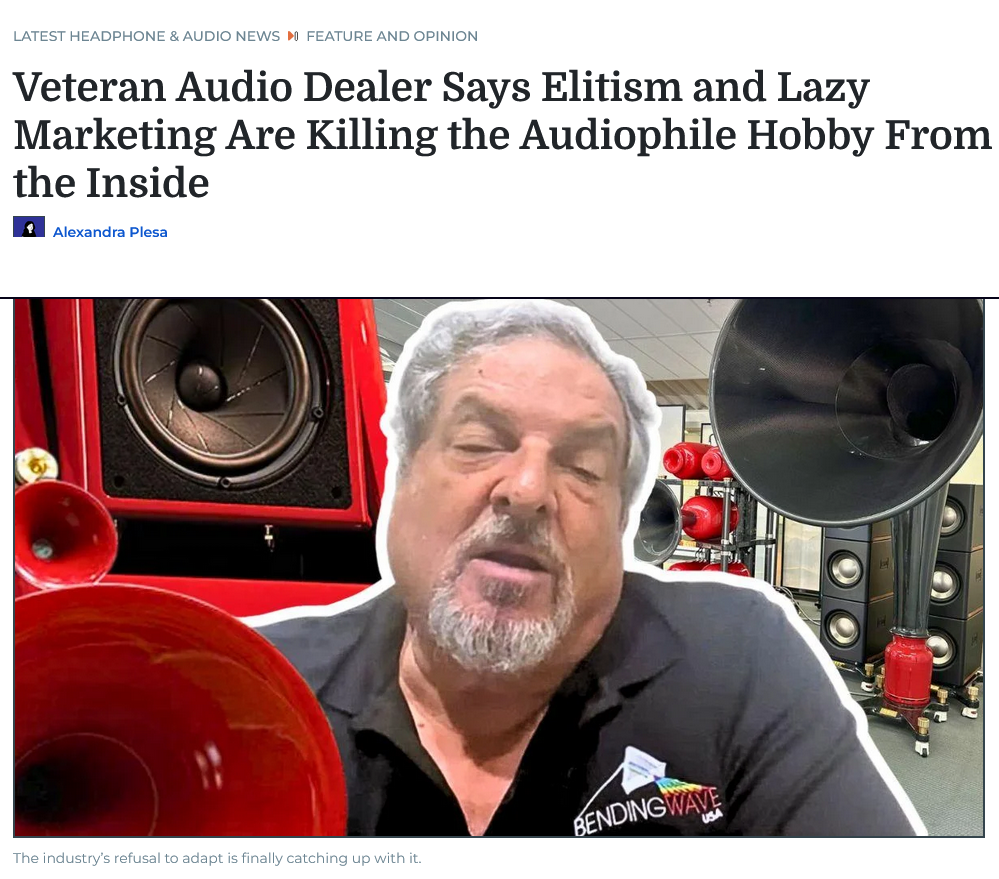
Elliot, a Florida-based audio dealer with over 50 years in the business, doesn’t hold back when it comes to what he sees as one of high-end audio’s biggest problems: lazy marketing.
“We’ve handed the business to the reviewers,” he said. “And we’ve given them a sense of entitlement and power that’s far beyond.”
In the past, a glowing review could move products overnight. He remembered the early days of The Absolute Sound, when founder Harry Pearson’s word was enough to make phones ring the next morning. That kind of influence is gone, and Elliot doesn’t think it’s coming back.
He’s seen it firsthand. His speakers have landed on magazine covers around the world. Sure, it did help make the products known at least to those who are already interested in them. But, it didn’t always lead to sales.
More than anything, he blames the industry’s unwillingness, or inability, to build real marketing strategies.
The real problem, he says, is that a lot of manufacturers are engineers, not marketers. So, instead of figuring out how to reach new audiences, they stick to what they know:
- Give a product to a reviewer.
- Wait for praise.
- Hope someone cares.
However, that approach doesn’t just fall flat. It sometimes causes more harm than good.
In 2024, British DAC maker dCS threatened YouTuber GoldenSound with a lawsuit after a critical review. The backlash was immediate. Fans sided with the reviewer, and trust in the brand took a hit.
That’s exactly the kind of mess Elliot says happens when companies rely too much on review culture instead of building their own message.
What the industry should do instead
He believes it’s time to try something else. One idea? Get a few dozen companies to contribute to a shared marketing fund. With the right team, they could hire a proper spokesperson—someone who knows how to connect with people, not just rattle off specs.
That approach may sound unusual in this space, but it’s already common in other industries. Car dealerships, for example, often pool money into joint advertising, even when they’re technically competitors.
And it’s not just about money, but also about tone.
Younger buyers don’t care whether something is “consumer” or “audiophile.” What matters is that it’s explained in a way that feels relevant. A 2024 study found that Gen Z prefers discovering gear through creators on YouTube and short-form video, not traditional reviews or legacy forums.
That’s what the audio world keeps missing.
How the Industry Is Pricing Out Most Music Lovers
The conversation revealed how astronomical pricing has become a central problem in high-end audio. For instance, Elliot has seen audio gear go from expensive to absurd. DACs at $300,000. Speakers at $600,000. And the prices keep climbing.
“The whole thing got caught up in ‘more expensive means better,’” he said. “And that’s a lie.”
Recent numbers back him up.
- Budget gear is booming while six-figure gear slows. Our mid-2025 popularity list is packed with sub-$200 “Chi-Fi” IEMs, while flagship loudspeaker shipments continue to shrink.
- Buyers are turning to used gear. HiFiShark has seen a steep rise in listings under $1k, while demand for gear above $5k has stayed flat.
- Subscription and rent-to-own models are catching on. Services like SoundClub now let users pay a monthly fee to rotate mid-fi gear, which is something cash-strapped listeners seem to prefer.
- Real budgets are far lower than manufacturers think. Deloitte’s 2024 Gen Z survey found most young adults spend no more than $400 a year on audio equipment.
These numbers explain the disconnect Elliot sees: while manufacturers chase ultra-wealthy buyers, most music fans are priced out from the start. And with cost of living so high in cities like Miami, younger people are already struggling just to stay afloat.
“Kids coming out of college can’t buy a house. They can’t buy a car. They don’t have that extra income,” he shared.
“Who are you going to sell that to?”
Despite that, the demand is there. Some luxury brands are starting to meet it. Focal’s $999 “Theva” speaker line, for example, sold through 70% of its initial run in three months. Buyers were clearly waiting for something more accessible, and they jumped on it.
Besides, young listeners are ready. They’re plugged in all day, already comparing earbud sound quality, and some are curious about what’s next. But the industry hasn’t made that next step easy, or affordable.
“We need to be less elitist and less snobby,” Elliot said. “And more inviting.”
Until that happens, most music lovers will stick with what they know. And brands will keep missing out on the next generation.
The ‘Incestuous’ Customer Syndrome
High-end audio has a habit of talking to the same group of people. Over time, that group gets smaller, older, and harder to excite. But the industry keeps going back to them anyway.
“The industry is very incestuous. It’s been selling the same customer over and over and over again.” shared Elliot.
New listeners aren’t the problem, though. In fact, they’re everywhere, like on YouTube, streaming music, wearing earbuds and headphones all day. But, they’re used to earbuds, Bluetooth, and convenience, not big amps and speakers.
Most young listeners stream music on their phones. In fact, 85% of people aged 18 to 24 say mobile devices are their primary listening platform
They’re everywhere, wearing earbuds or headphones, and constantly connected to music. But they’re discovering gear through short-form videos and creator playlists, not traditional magazines or forums. And when brands do speak, they often talk past them.
The issue isn’t that they don’t care about sound. According to Elliot, a lot of them already notice the difference between cheap and decent headphones. With the right introduction, some might move up to real systems. But they’re not getting that opportunity.
Elliot’s seen what happens when someone stumbles into better gear.
He said his best customers are usually people who weren’t even looking for high-end gear. They just walked into the store, heard something better than what they expected, and got pulled in. They didn’t know this level of sound even existed.
The problem is, those moments happen by chance. And the industry doesn’t seem interested in creating more of them.
The Problem With Having Shows Every Month
Audio shows are everywhere now. During the first half of the year, there’s one almost every month. But for at least one longtime dealer, they’ve become more of a drain than a strategy.
“The amount of shows is stupid and the results from shows is even stupider,” he said bluntly.
To be clear, he isn’t against shows completely. He’s done plenty of them. But in his experience, they rarely bring in new customers or deliver truly impressive demos. Most visitors aren’t there to buy. They’re just passing time.
He called it “audio tourism.” People poke their heads in between errands or while waiting on their partners, with no serious interest in gear. And even when they do sit down to listen, the sound usually isn’t anything special.
“Most of the sound at audio shows is just average,” he said. “I don’t think most people go to an audio show and get their doors blown off.”
Some of the industry’s frustration now comes from logistics. In 2025, several major events like AXPONA, SIAV in Shanghai, and Kaohsiung Hi-End Show all happened on the same weekend. This forced brands to pick sides on where to spend money and manpower.
And that money doesn’t go far. Booth costs, labor, shipping, and lodging have all gotten more expensive, yet most companies still have no clear way to track return on investment.
Even shows that report big turnouts aren’t necessarily bringing in the right crowd. AXPONA 2024 hit over 10,000 visitors, but the new Gen Z ticket tier, despite some growth, still made up a small slice of attendees.
“It’s the same thing over and over and over again,” he said. “There’s nothing unique about any of them.”
He doesn’t think shows need to disappear. But if the goal is to grow the customer base, this isn’t the way.
Why Most Audio Brands Won’t Survive the Next 10 Years
After talking through the problems with pricing, marketing, and customer outreach, the conclusion was simple: if the industry stays on its current path, a lot of audio brands won’t last.
The warning signs are everywhere, as many familiar names are already in trouble.
In early 2025, Harman acquired Masimo’s consumer audio brands, including Bowers & Wilkins, Denon, Marantz, and Polk, in a $350 million deal. The portfolio, once part of Sound United, had been posting losses for several quarters, and insiders called the sale a lifeline rather than a win.
It’s all about a shrinking market.
Recent reports show home audio sales dropped 7.7% year-over-year in 2024, both in volume and in revenue. And, the trend is expected to continue through 2025.
Meanwhile, consumer money is flowing in a different direction. Headphones and earbuds are booming, with the global market now worth $69 billion and projected to hit $103 billion by 2030.
That’s what worries Elliot the most. It’s not just that sales are down. It’s that no one seems interested in changing how the industry works. Collaboration is rare. Outreach is limited. The same cycle continues, even when it isn’t working.
However, he believes there’s still a chance to turn things around. People still love music, and there are ways to show them what good audio can do. But that will take a different mindset, one that doesn’t wait for the same few customers to come back again.
“The industry just has to look at it and say, ‘Hmm, we need to change something,’” he said.
Without that shift, he sees a slow decline. Not because people stopped caring about sound, but because too many companies refused to adapt.