You have 0 items in your cart


To read the original article, click here.
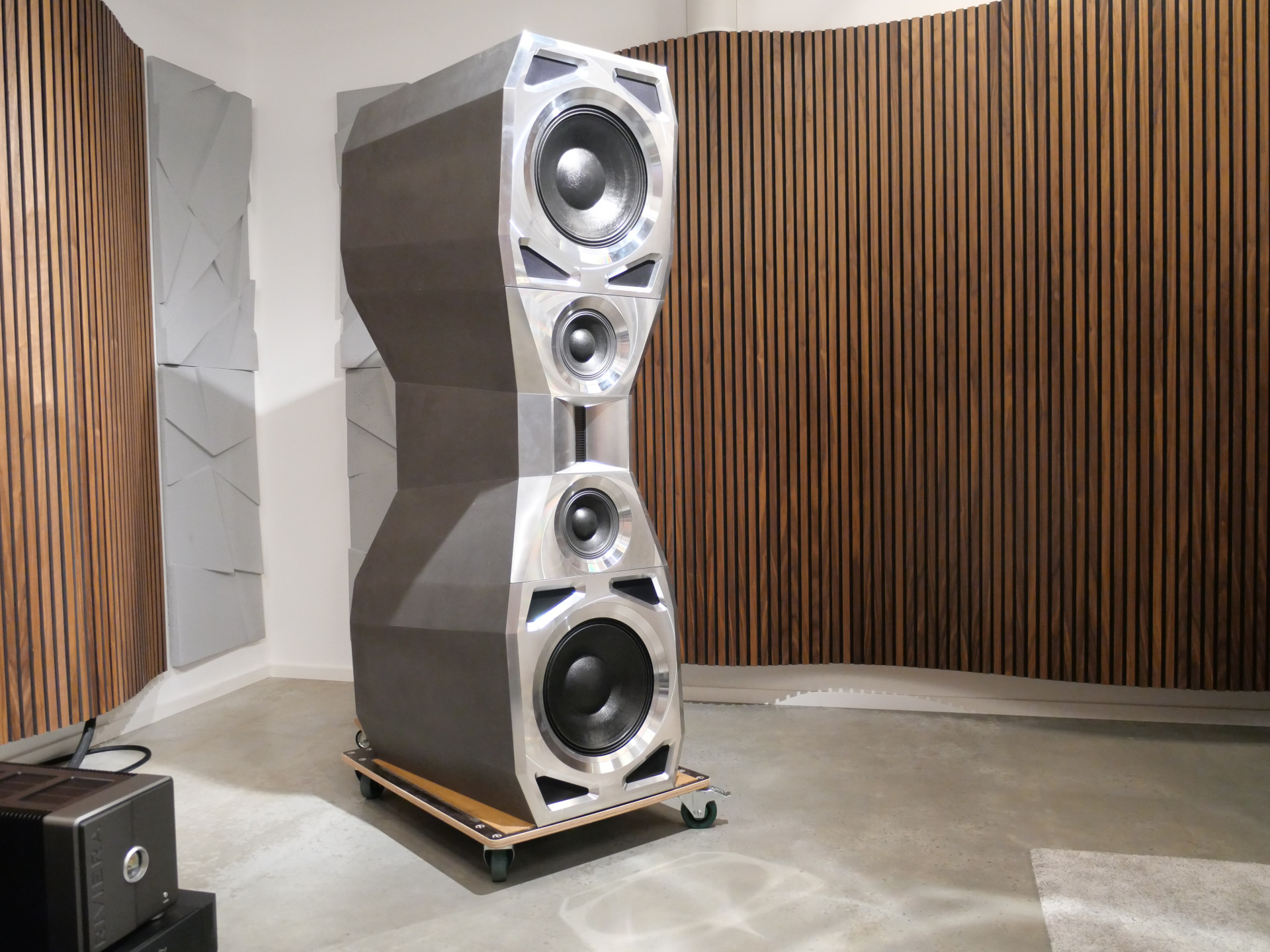
 I’ve never been a fan of reviews based on manufacturer visits – what the late, great Paul Messenger referred to as Awaydays (channeling the spirit of cheap tickets on British Rail). But for all that, not all Awaydays are created equal – and not all of them are avoidable. For some products, a report (as opposed to a review) based on a site visit really is the only alternative. They’re just too big, too heavy and too downright demanding to fit into the conventional review process. Göbel’s massive, €600,000/pr. Divin Majestic speakers are a case in point. Let’s assume that you have the space to accommodate a pair of very large box speakers measuring 226cms (or almost seven-and-a-half feet) tall. With an all up weight of 530kgs (or a shade short of 1,200 pounds) each, the logistical challenges are little short of monumental. Each speaker arrives as three separate cabinet elements, which you might think helps – except that you’ve got to stack them. That means lifting the 210kg mid/treble enclosure onto the bottom bass cabinet, before placing the upper bass cabinet (a mere 160kgs) on top of that – with the mating surface around five feet off of the ground. Ohh – and you have to accomplish that without damaging the flawless, real piano lacquer finish. Repeat that operation and then you have to find a home for the six, large flight cases and the far from small accessory box. And that’s before you un-box and stack the six Sovereign sub-woofers (€35,000 each) and store their flight cases too.
The heavy lifting is only the first stage of the exercise. You also need to have a suitable system to hand, preferably with four channels of amplification to bi-amp the main speakers, plus enough cables to feed the resulting system – all from the same source. Organising such an exercise might be possible, but it would involve both massive effort and disruption, let alone serious cost. Under the circumstances, it’s not hard to understand why the attractions of a ‘manufacturer visit’ start to outweigh the improbability of ever achieving a home loan. You just need to keep in mind that the two things are not the same, most obviously because you can’t even begin to isolate a single component in an alien system and environment. Awaydays are experiential reports: This is what I heard on this day, under these circumstances. Anybody drawing detailed, comparative conclusions as a result is deluding themselves as well as misleading their readers.
Having said that, not all Awaydays present the same challenges. I’ve never had the Divin Majestic at home – but I have spent time with it in three different locations, including the Göbel factory listening room. I’ve spent less time with the Sovereign subs – and crucially, I’ve never set them up – but that will be rectified soon as they are due for review shortly. So the subjects of the visit are at least somewhat familiar. But what really helps things along is the rest of the system and the room. Source is a full Wadax ‘Level 8’ Reference system, feeding CH Precision 10 Series electronics – all of which I do know, inside out. Add to that proper attention paid to detailed set-up, coherent cables and supports, a room in which I’ve previously spent considerable time and a side-dish of Vitus Masterpiece electronics as a point of comparison and this particular visit already has something of a head-start.
That system in detail:
Wadax Reference Transport/Akasa Optical cable, Reference PSU and Akasa DC cable
Wadax Reference Server/Akasa Optical cable, Reference PSU and Akasa DC cable
Wadax Reference DAC with Dual Akasa Optical input module and Akasa DC cables
CH Precision L10 Line-stage (+2dB input gain, Local feed-back setting)
CH Precision M10 Power Amp x2 (bi-amp mode, -1dB input gain, 0dB channel off-set, 0% GFB)
All electronics supported on Göbel stainless-steel/ceramic couplers, mated to FalkenOhr racks or amp-stands (apart from the Wadax Transport and its PSU, which were placed on finite elements amp-stands, awaiting the arrival of another FalkenOhr rack).
All power, signal and speaker cables – Göbel Lacorde Statement
Göbel Divin Majestic Loudspeakers
Göbel Divin Sovereign Sub-woofers x6
Vitus Masterpiece MP-L 201 Mk.II Line-stage and 2x MP-M 201 Mk.II Mono-blocs
The Listening Room
8.5m(W) x 12.5m(L) x 3.7m(H)
Bare, polished concrete, with thick, central wool rugs.
Walls constructed from layered hard-wood and damping layers, 15” thick.
Ceiling, 8” laminated hardwood.
Custom built dispersion, targeted absorption and ‘clouds’ to create a lively, even acoustic.
Dedicated AC supply, totally independent of workshop and domestic feeds.
Taking advantage of the size of the room, speaker placement and listening seat follow a modified Rule of Thirds, with the stacked sub-woofers in the front corners: it’s undoubtedly somewhat daunting to have a speaker this large, that close, but it’s a placement that proved spectacularly effective in maximising the (musical) use of space and minimising (intrusive) system or room artefacts. Initially, it’s also slightly disconcerting to have speakers this large standing mute, as the performance goes on, completely independent of their solid, slightly brooding presence but, believe me, you soon get used to it.
What should you expect from a system like this? There’s an almost irresistible temptation to reach for the biggest, loudest recording you have, just to see if the ‘promise’ is real. In this case, that might be (seriously) gratifying, but it would also be to miss the point. Past experiences with the Majestics have left me with an abiding impression, despite their imposing presence, of just how astonishingly well they do ‘small’. Add a six-pack of sub-woofers and that capability becomes even more impressive.
With that in mind, the first disc I reached for was Víkingur Ólafsson’s Debussy-Rameau (DGG 4837701) – a big instrument but playing full of restraint, delicacy and temporal sensitivity. The system conjured a solid, credible, life-sized piano, planted in space. It didn’t move or waver. It didn’t shimmer. It offered a solid, substantially dimensional space, defined by the notes and harmonics of the playing. Note weight and attack were beautifully clear and natural, graduation and pace through the phrases fluid and articulate. But the ‘gotcha’ moment came at the first pause in ‘La Demoiselle élue’, as the harmonics of the last chord played extend – and extend – and extend… before being silenced by the damper. The complex harmonics are impressive enough: I’ve never heard their interlocking layers so clearly defined or seem so vibrant: they’ve never seemed to hang for so long, yet despite that, their sustained length seems not just natural, but just right. Yet the kicker comes after the pedal. As Ólafsson damps the chord it reveals absolute quiet. This isn’t the clichéd ‘black back drop’ we hear so much about. It’s not transparency. It’s not a lower noise floor – at least not in the conventional sense. There’s none of the grain, texture or almost sub-audible presence you hear from every other system I’ve ever listened to. This is complete, utter, silence…
Optical disc bites back…
What I’m describing here is, of course, system performance. Most systems aren’t this sorted, most rooms aren’t this quiet. But a big, big part of this is the contribution of the Reference Transport. Listen to Wadax’ latest mechanical, optical and electrical magnum opus and it’s obviously different to more familiar disc players. It has a solidity, dimensionality, presence, a natural sense of proportion and absolute stability that surpass any other source component I’ve used – but that doesn’t quite isolate what makes the Reference Transport so special. It wasn’t until I was discussing the Transport with Stirling Trayle and he mentioned the utter silence against which the Wadax presents the recording that the pieces fell into place. As soon as he articulated the quality, I recognized exactly what he was talking about – and its significance. But the significance here is not what the Transport can do, but just how clearly and utterly unambiguously the speakers reveal it. The Transport might have a silent background, but so too do the Divin Majestics – and that’s rarer than you might think.
This silent underpinning has a profound musical and presentational impact. Play something as hackneyed as Brubeck’s ‘Time Out’ (from the album of the same name, Audio Nautes AN-2511-KD) and there’s a newly explicit quality to the timing and note length that invests this most familiar of audiophile clichés with a new sense of expressive range and engagement. I’ll come back to jazz (and horns in particular) in a moment, but first, let’s go smaller still…
Isabelle Faust and Giovanni Antonini’s Locatelli disc, il virtuoso, il poeta (with Il Giardino Armonico, Harmonia Mundi HMM 902398) is a recently released delight. The small group arrangements are played with real vigour and purpose, while Faust clearly delights in the extravagant displays demanded from the soloist. This is an air guitar recording for classical fans, with the sort of musical engagement and dynamic contrasts that positively encourage the frustrated conductors amongst us. Possibly my favourite track on what is a consistently excellent album, is the Violin Concerto in A major, Op.3 No.11. The first movement features a rhythmically robust and energetic opening that sets up a stark contrast with the solo part, a part whose fragile line seems to extend ever upwards until it’s teetering on the very top registers of the violin, before swooping down to engage with the orchestra’s enthusiastic recapitulation. The system makes the band’s concentrated energy, life and intent effortlessly convincing and engaging. But it’s the combination of poised delicacy, focus and stable presence that it brings to the solo part that’s breathtaking. I literally found myself holding my breath as Faust navigated her instrument’s upper limits with a virtuoso display of balance and technique. But this system goes further and deeper into the music than that. It was possible (almost impossible not) to visualise Faust’s bowing, while the phrasing, subtle pauses, prompts and accents in the line were as natural as they were clearly played. It was a performance that, at the end of the movement provoked spontaneous applause from the (non-classical) listeners present – a response that pretty much says it all.
This ability for instruments to be simultaneously both substantial and delicate is one of the great divides between live performances and recordings of them. It’s a chasm that this system bridges effortlessly. Whether it’s the astonishing dexterity, precision and focussed energy of Sol Gabetta dominating Vivaldi’s Winter from The Four Seasons (with the transcription of the first violin’s solo part for cello, Il Progetto Vivaldi 1-3, Sony 8887503952), the delicacy and artistry of John Williams’ picking, the attack and tonal density in his strummed chords (the beautiful Danzas Peregrinas from Concerto, JCW3 on his own label) or the vivid energy and intensity of Anastasia Kobekina’s playing, the subtle accompaniment and explosive interjections of the tambourine, on the track Gallardo (from Ellipses, Mirare MIR604), there’s a natural sense of uncompressed energy (micro or macro), dynamic graduation and proportion that is vividly, compellingly convincing.
Gentle giants…
What makes a speaker system this large and this physically imposing so easy to ignore and ultimately forget? The key lies in that presentational quality that’s so apparent in these smaller recordings: quiet. It also lies in the fact that whilst the Majestic might look like a conventional, dynamic loudspeaker, albeit one built into a remarkably complex shaped cabinet, there actually almost nothing conventional about the drivers or the cabinet. Despite appearances, the Divin speakers apply a unique approach and unique technology to a familiar problem, an approach and technology that are clearly reflected in the unique results achieved.
Of course, every loudspeaker manufacturer claims that their speaker is different, unique and superior. But in Göbel’s case, those claims are a whole lot more credible while the superiority of the results speaks for itself. The company started life by designing and building an innovative, almost full-range, bending wave, flat-diaphragm drive-unit roughly the size of an iPad, a discipline that demands considerable understanding of materials and controlled resonant behaviour in a flat surface. That driver and the speakers it spawned, still exist – and still have their die-hard advocates. On the surface, the huge, multi-driver, ported cabinet Divins couldn’t be more different. But the cabinets and proprietary drivers are the result of exactly the same knowledge base. If a drive-unit depends on maximising even, wide-bandwidth output while eliminating unwanted resonance, designing a speaker cabinet involves minimising the self-same things: the same knowledge base, techniques and understanding, just applied in the opposite direction. The results are clear to see once you dig below the surface of the Divin speakers.
If we start with the drivers, the tweeter is a horn-loaded Heil AMT, a legendary driver but one that designers have always struggled to mate to conventional, dynamic bass or mid drivers. In the Majestic, Göbel attacks the problem in two ways: It uses the horn loading to help extend the output of the AMT down to 1,600Hz, where it’s mated to a pair of 8” midrange drivers, using shallow 6dB slopes. The midrange drivers run down to 120Hz where they crossover to the 18” bass units, again with a shallow 6dB slope, the whole forming a symmetrical D’Appolito array. The drivers use low-mass, cellulose cones mated to large diameter, ultra-light, fibre-glass voice-coil formers to help avoid thermal compression and variation. Instead of terminating the diaphragms with lossy, rubber surrounds, the company employs pleated fabric in order to maximise low-level resolution and driver efficiency. Resonant behaviour is controlled through the use of highly evolved diaphragms, specially developed coatings, dust cap geometries and materials, a direct development of the approach and techniques used in the bending wave driver. The result is drive units that might look conventional but employ distinctly different approaches to achieve a very specific end.
The cabinet accounts for most of the speaker’s enormous weight. As described above, it is separated into three, discrete enclosures, isolated from each other by composite cork/rubber layers placed between them, helping reduce intermodulation distortion. Each enclosure is constructed from 40mm thick constrained layer panels, with multiple layers of melamine resin material bonded together using soft-setting polyurethane glue. Careful calculation of dimensions and bracing creates an enclosure that is able to absorb considerable energy, converting it to low-level, broad-band mechanical output, with none of the peaks or spikes that afflict most cabinets. Individual, machined aluminium baffles are mounted to the front of the enclosures ensuring a precise and solid mechanical reference for the drivers. Combine the enclosure and the aluminium elements and the midrange drivers are anchored to an 11cm/over 4” thick baffle. But controlling resonance and mechanical feedback in the cabinet is only one half of the story. The other half is concerned with the behaviour of the enclosed air-mass.
Outwardly, one of the Majestic’s more obvious features is the four reflex ports, arranged symmetrically around the bass drivers. These are deployed to ensure even pressure patterns behind the driver, eliminating any torsional or rocking influence that might push the diaphragm off-centre, something that massively increases distortion levels. The tapered cabinet walls eliminate parallel surfaces and standing waves within the enclosed volume, but internal resonance is cancelled using a sophisticated combination of internally mounted, carefully tuned, Helmholtz resonators and ceramic foam ‘velocity dampers’. The bi-wirable/bi-ampable crossover is isolated in its own chamber, behind the mid and HF units and, as well as all the exhaustively selected expected audiophile grade components, includes impedance compensation that delivers a near flat 4Ω load.
The result is a loudspeaker that not only controls and maximises output from its moving parts, but minimises the influence of its cabinet (or stationary elements) – the latter to a quite remarkable extent. This is a low-loss design approach, minimising both the loss of energy in the system and the loss of information. System sensitivity is 98dB, bandwidth extends down to a -3dB point at 21Hz, while the non-reactive 4Ω load makes the most of the driving amplifier’s output, something that’s further extended by bi-amping. In fact, it could be argued that Göbel are actively courting the displeasure of consumer groups everywhere by describing this as a ‘loud’speaker, when it’s actually a very ‘quiet’speaker indeed: quiet in terms of unwanted acoustic output; quiet in terms of intrusive colouration or spurious energy polluting the signal. Quiet enough to capture the tension and fragile, delicate energy of the top string on a violin. Quiet enough to separate the rattles on Ólafsson a tambourine, the explosive slap on its skin and the air cushion contained within its frame.
Well – if we must…
It’s finally time to give in to our baser instincts. What works for ‘small’ also brings real qualities to ‘large’, and I do mean real. Few systems can match the scale presence and dynamic range of an orchestra, but this Wadax/CH/Göbel set-up gets as close or closer than any I’ve heard. The Batiashvili/Barenboim concert recording of the Tchaikovsky Violin Concerto (UHQ-MQACD, DGG UCCG-41048) is produced with really convincing scale, energy, space and spread. Dynamics swell without constraint, the heavily populated stage appears behind and beyond the speakers, instrumental groups distinct and separate, the soloist focused but not over voiced. This is one of the most convincing orchestral presentations I’ve heard from an audio system. It’s not real – at least not in the sense that you think you are there, at the event – but it lets you know clearly and unequivocally, just what it was like to be there. Has the gap between real and reproduced has never been this short? Not in my experience.
But as engaging, exciting, involving and plain exhilarating as her Tchaikovsky recording is, it’s another Batiashvili performance that really underlines the fundamental musical qualities of this system and these speakers. The recording quality of her Shostokovich Violin Concerto No.1 (with Esa-Pekka Salonen and the Symphonieorchester Des Bayerischen Rundfunks, another UHQCD, DGG UCCG-UCCG-52086) might not match the immediacy, presence and energy of the Tchaikovsky disc, but the scale and demands of the music and the way she responds, put this performance on another level. Ironically, what really underlines the emotional intensity in the playing is the almost tortuously extended solo passages in the Passacaglia, but the balance and communication between soloist and orchestra is just as intimate, the shifts in dynamic level and density, tone and (perhaps most importantly of all) mood, unrolling before you like a musical journey. It’s what I call a 3D experience – but here the dimensions are musical. This system is dynamically coherent, temporally coherent and spatially coherent too. Together those things add up to a remarkable sense of performance, everything in its place, doing what it should, when it should.
The speaker’s unburstable dynamic range and uninhibited dynamic response inject life and energy into the playing, the temporal exactitude keeps things on track and pointed in the right direction. When the score builds, so does the intensity and level, but the instruments never wander on the stage or crowd forward: just listen to the helter-skelter plunge from solo instrument into the full-bore finale of the third movement. Even more impressive, when the music hesitates or stops mid flow – it stops dead, with that special silence that the Wadax reproduces (and the speakers preserve). That, more than anything else, demonstrates just how little smudging, slurring of leading edges or blurring of harmonic tails the speakers (or more precisely, their cabinets) append to the signal. This is a far from great recording, but it’s a fantastic performance, from soloist and orchestra alike – and this system makes that plain, fastening on the musical integrity, simply brushing the compromised recording aside.
In fact, this system makes the musical performance king, the quality of the players and their playing trumping all other considerations. It makes the most of concert recordings or one-take studio tracks so, for instance, while DGG’s Kleiber Beethoven 5 and 7 SACD is undoubtedly excellent, it’s easily bettered by the sheer sense of occasion manifest on the Orfeo live recording (Orfeo SACD C700 051 B) of Kleiber conducting the Seventh Symphony with the Bayerisches Staatsorchester.
Talking of 3D – in the more widely understood sense – stereo spectaculars, like ‘True Love Ways” from the Buddy Holly Legend album (MCAD-5540) are, well, spectacular. The control-room speaker that opens the track is wa-a-ay stage-right, the stage itself extends well beyond the speakers, broad with a clearly defined floor and rear wall. The strings, harp and sax are located right, clearly arrayed in space, the Crickets are on the left, even the gently strummed guitar clearly audible in the overall sound: and Buddy’s voice? Buddy’s voice is intimate, present and life-sized, correct in terms of height and with a solid, dimensional physique behind it. You want reach out and touch – this is it.
Personal service…
That physical sense of energy extends across the range. Play the Art Blakey track ‘Moanin’’ (Blue Note UHQ-MQACD-UCCU-40120) and the tonal density of the brass instruments, the attack and action of the piano, the clarity and pitch of the bass notes and the location and separation of the instruments produce a vivid, punchy sense of presence and vitality. When Lee Morgan lets rip in his first solo, Bobby Timmons’ muted, subtle piano prompts are just where and when they should be. Enter the sax and its reedy tonality is so distinct and separate from the trumpet that there’s no confusing not just the instrument but the nature of the sound it produces. Blakey’s drumming has slap, attack and a propulsive rhythmic precision, Jymie Merritt’s bass solo is articulate and fluid, a world away from the limp, muddled stumble that most systems produce. You want live, club levels? You’ve got them. You want to know what it’s like to sit in front of Lee Morgans horn? You will…
There seems to be little or no limit to the demands you can place on the scale and headroom available from this set-up. Monster sound-tracks hold no fear for these speakers: you will give up before they do. The sheer scale and subterranean bass that forms the foundation of Hans Zimmer’s music for Thin Red Line (RCA/BMG 09026 63382 2, pre-Gladiator and surely Zimmer’s finest work) hasn’t sounded this enveloping and physical since I last heard it in the cinema. Yet for all that power and substance, it still shimmers with atmosphere and tension. ‘Shenzou’ from the Gravity OST (Silver Screen SILCD1441) is the audio equivalent of a toboggan ride on even a modest system: here, it’s the Cresta Run! Both soundtracks were reproduced with solid, slab-like low-frequencies that arrived on time and on pitch, with clarity and a complete absence of overhang – testimony to the room’s deft low-frequency voicing – but the sub-sonic output set the air in the room wobbling like a blancmange sitting on a spin-drier: Not strictly relevant to musical capabilities, save as a demonstration of genuinely prodigious bottom-end output capability and control. The word “awesome” has become almost meaningless in current parlance, too often used to describe the merely good or acceptable. Check the dictionary: this was properly awesome!
Don’t go getting the idea that this is a system for classical music and a bit of jazz. I might have reached into that side of my collection for the examples cited so far, but I listened to plenty of rock and pop too. ‘Soul Love’ and the title track from Ziggy (EMI SACD 07243 521900 2 7) effortlessly conjured the magic of Bowie and the era of UK rock recording on 2” analogue tape. The spit, sawdust and attitude of Americana was raw and ready, the sculpted soundscapes of Aimee Mann’s Lost In Space (MoFi UDSACD 2021) dripped texture, detail and ambience, filling the space behind her bruised, sardonic vocals. Songs with a downbeat tempo (like ‘Real Bad News’) never dragged or lagged, the driving rhythms and hitch-kick pick up of ‘The Moth’ were properly propulsive and motive, passing the Linn toe-tap test without even recognising the issue.
Home comforts…
But it was with familiar voices that the preternatural qualities of this system were most apparent. Whether it was Steve Dawson (and Diane Christansen) on Sweet Is The Anchor (UndertowCD-UMC-028), or Eleanor McEvoy on Yola (Mosco EMSACD1) the familiar character, accent, diction and delivery were immediately apparent, their identity in no doubt at all. However, there’s no escaping the fact that those examples are essentially simple, sparse recordings that offer a clarity and intimacy that’s rare on mainstream discs. How about something more testing? It’s crying out for Prog… Roll together the system’s ability to support and separate complex layers and congested mixes, over-dubs and drop-ins, to cut to the heart of the music, almost despite the recording and what better challenge than Foxtrot (Genesis – SACD from the 1970-1975 box-set)? If you had any lingering doubts as to both the linearity of this speaker system, or the system’s ability to overlay strands of musical information without congestion or muddling, this album will banish them. This is a production in the full kitchen sink tradition of Prog Rock excess, with swirling keyboards, multiple guitar overdubs, incidental snatches of sound and ‘character’ voices. But listening here, the soundscape opened out, Collin’s powerful drum patterns emerge, as does the seldom audible but beautifully paced and shaped bass guitar line. And then there’s THE voice: this is Gabriel at his finest, expressive intimate and unmistakable. I grew up with this album. I’ve heard it hundreds and hundreds of times – like you do at school. I’ve recently rediscovered it and enjoyed it on the sort of systems I run at home. But I have NEVER heard it sound like this!
Having the Vitus amps on hand offered a fascinating contrast. Warmer and tonally more rounded than the 10 Series, they lacked the sheer clarity, easy organisation and dynamic immediacy of the Swiss amps. For me, the CH electronics were the way to go, although I can see how the sweeter, warmer, more mellifluous sound of the Masterpiece amplifiers might appeal. They moved the system closer to the familiar environs of mainstream, high-end sound. But, like those other mainstream systems, the performance lacked that shorter jump to reality that made the Wadax/CH/Göbel system so compelling, entertaining and effortlessly involving, at least for me. of course, your view may well vary and this system depends in large part on products that I have already chosen – the Wadax and CH Precision. What the switch to the Vitus amps also showed, was the chameleon-like quality of the Majestic/Sovereign combination, their seamless integration, transparency and neutrality. This is a speaker system with colouration levels lower than many amplifiers – and certainly less intrusive than most digital replay systems.
Is there anything this system cannot handle, big or small? If there is, I’ve yet to find it. Is this system perfect? Certainly not – as witnessed by its response to tweaking and adjustment of the highly configurable electronics. Is it fit for purpose and capable of being fitted to taste? Undoubtedly. I normally approach subwoofers that run DSP packages and Class D amplifiers with considerable caution. But in this case – and as we’ll see in the separate review due shortly – the control interface and performance of the Sovereigns seem to finally deliver on the technology’s promise. It’s as intuitive as it is powerful, adding a whole new foundation to the already impressive low-frequency capabilities of the Majestic. In a situation like this, you can only report on the system, but what a system! The best I’ve enjoyed? I’ve heard some great and truly memorable systems over the years, but this system, on this day, in this form and with this set up – top of the list.