You have 0 items in your cart


To read the original article click here.
 Oliver Göbel presented the Divin Comtesse at last year’s high end: The two loudspeakers, which are petite for Göbel-high-end ratios, have impressively sounded the large room in conjunction with a subwoofer. Now the series production has begun and a couple has found their way into my listening room, but it had to move again.
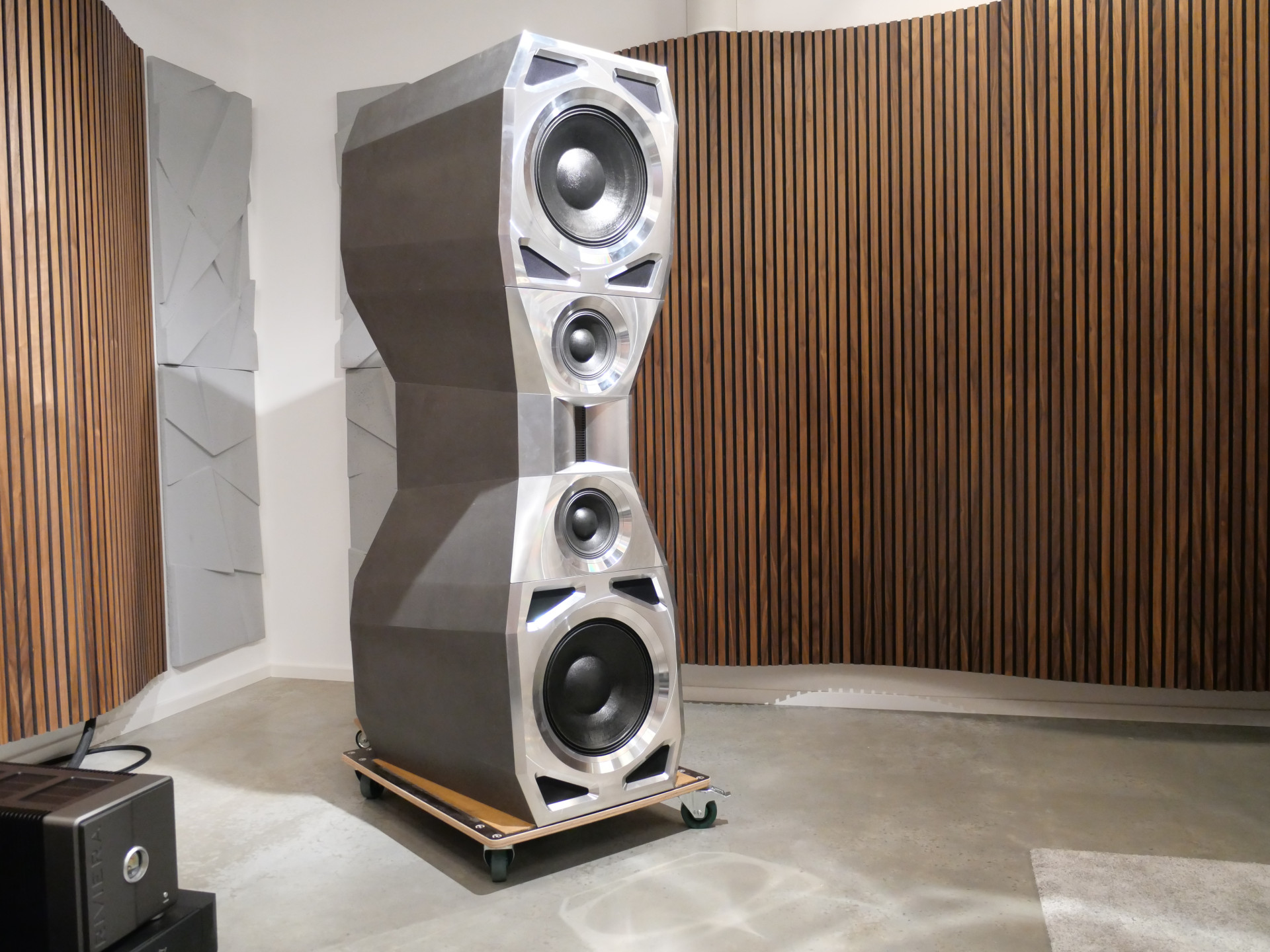
The Comtesse is the smallest model in the Divin series and thus also the entry into the entire loudspeaker portfolio of Göbel-High-End. The company owner explained that his distributors in non-European countries had wished for a less space-consuming loudspeaker, since a part of the customers there had the audiophile claims, the financial resources, but not the space for larger sound transducers. Therefore, the development of the Comtess was primarily about realizing a large part of the tonal abilities of the previous members of the Divin line with a smaller volume. The turnout of the Comtesse is just as elaborate as that of the Marquis. The 8-inch long-stroke engine is similarly costly to the 12-inch chassis of the next largest model, mid-range and tweeters are identical and the savings are almost negligible due to the slightly smaller case. The Comtesse offers unusually much Göbel high-end technology at a comparatively moderate price.
For example, the midrange driver of the Divin Comtesse is an 8-inch chassis specially developed for Bavarian high-end forge, in which the patented Göbel® bending wave technology was implemented, which is based on the principles of sound generation by musical instruments and is the result of more than 15 years of development work. They invested in achieving the most natural sound possible. The tweeter range is handled by an AMT – or Air Motion Transformer – to which a waveguide milled from a solid aluminium block has been adapted. The specific curve course of this waveguide ensures a flawless combination of all chassis into a homogeneous and natural sound. In the low-frequency range, a Göbel® 8-inch long-throw woofer is intended to achieve absolutely homogeneous sound radiation and stimulation of the room modes. This chassis, specially manufactured for Göbel, was placed on the front sound wall with “Constraint Layer Damping”, in which layers of different materials dampen each other, in such a way that an absolutely smooth transition of the 8-inch midrange to the low frequencies of the long-stroke woofer is created. In the case of housings, the use of multi-layer tropical-resistant materials should guarantee the ideal ratio of stiffness and damping behavior and eliminate the selected, purely functional shape of any diffraction, resonances and energy-storing effects.
The top model of the Devin series, the Majestic, is delivered in six flight cases, as I learned during a visit to the company headquarters. Even at Göbel High Ends, the cheapest loudspeaker, the Comtesse, a German-made flight case is included. For the delivery, Oliver Göbel had thankfully brought an electric staircase climber, so that the two sound transducers entered the listening room without tug-off. After standing there roughly in the proven places and connected with Göbel loudspeaker cables with Einstein’s The Poweramp, I left Oliver Göbel with an iPad with Qobuz access alone in the listening room. He simply needs rest, his test tracks and plenty of time to set up his sound transducers in such a way that they unfold their full potential. Well, one reason for my temporary withdrawal could of course also be that among his test files was a series of vocals…
When I returned to the listening room and heard the first short excerpts from my favorite pieces, I surprisingly did not miss anything – although I have been enjoying the several times more expensive Børresen 05 SSE for a while now: In terms of timbre, dynamics, resolution and spatial representation, the Comtesse left nothing to be desired. I was particularly amazed that the Comtesse sounds so much bigger than it is: For the Divin, it is easy to depict sound events even above their housing. I usually automatically close my eyes when I hear it is concentrated. With the Göbels, however, it becomes a duty: otherwise, the visual impression reduces the image to the box height. Without eye contact, however, you feel like a much higher sound source. Just great.
But that’s not enough. Oliver Göbel insisted that I also listened to one or the other singer. And that was much more pleasant than feared. One could say that voices were the prime discipline of the Comtesse, it did not act in all other areas at the same very high level. Short time jump: After the 05 SSE had returned to the listening room, I also played some songs about it, in which the Comtesse excelled with its voice reproduction. As homogeneous and holistic as the Göbels, the Børresen, which I highly valued, could not reproduce female voices. But now back.
The fact that despite all its merits, the Comtesse did not stay in my study for too long was due to the fact that after the first euphoria it became increasingly clear that they too could not perform miracles and solve the acoustic problem of my listening room. Recently I have described in quite detail the aural advantages and disadvantages of the room : It has almost no abnormalities, behaves neutrally and allows a complete detachment of the sounds from the sound transducers. However, the frequency response has a very narrow-band, quite low slump around 64 Hertz with the vast majority of speakers. As with all sound transducers with woofers, this is also noticeable in the comforts of the Comtesse on the front side in the vicinity of the ground. I find this increasingly disturbing since the Børresen 05 SSE, with the upper of its four woofers, which has only a small distance to the sloping roof, stimulates the room in such a way that the hole disappears in the low-frequency area: it is neither to be perceived nor to measure.
Since the Comtesse really inspired me in a short time both to listen to pleasure and with the relevant test track, I wanted to offer her better spatial conditions. As I could tell after the move of my Göbel Epoque Aeon Fine from the working room to the living room, it makes it easier for the latter loudspeakers, especially in the bass area, many times more: Here, there is neither a hole in the low-frequency range nor thick room modes disturbing the lower frequency range. Since the left box has less distance to the roof slope than the right one, however, the balance shifts a bit to the left, especially with high loudspeakers such as the Acapella Violon VI – an effect that was already less pronounced with the less high Epoque Aeon Fine. That’s why I suggested to Oliver Göbel to build up the Comtesse once in the living room. He didn’t hesitate for a moment and immediately agreed. It took much longer to persuade the perfectionist to get the Divin out of the study. Although the topic of listening space was already ticked off for me, he did not miss the opportunity to experiment with the creation of the Comtesse for over an hour in order to minimize the effect of the low-frequency intrusion, which he succeeded with a line-up of the listening chairs very close to the back wall, but in my opinion has a negative effect on the sense of space.
Perhaps I should add that the move to the living room should not be rated as an audiophile descent, since the facility there has improved significantly in recent years: Einstein’s The Preamp and The Poweramp are taking over the reinforcement. They are connected to a symmetrical Swiss Cable Reference Plus and there is an Audioquest Dragon Bi-Wire between the amplifier and the loudspeaker. The room is connected to the network with media converters fed by linear power supplies and a single-mode duplex optical waveguide. Digital signals are processed by Chord Electronics’ M-Scaler and converted by a Hugo TT 2. Usually, a 2GO and a 2YU – also from Chord Electronics – serve as network transport. But I did not want to put up with these little boxes Oliver Göbel and the Comtesse. Since I had the best experience with the Lumin U2, I asked Krey Baumgartl for an exciting alternative. He suggested the brand new T3X, which I could use as a network transport before a colleague subsequently tests it.
The already recorded Lumin T3X was then part of the chain when Oliver Göbel and I built up the Comtesse in the living room. This was much easier than the installation in the study. The developer minimally varied the distance of the speakers to the listening area and experimented a little with the angle and it was already suitable – at least for me. Oliver Göbel had to find out for himself whether, and if so, how negative the placement of the hearing sofa directly in front of a wall had. Finally, he suggested moving it between 20 and 30 centimeters further into the room, which I tried for a few slices also with success. Since I do not have the last word in the living room in terms of hifi, this lineup did not become a permanent solution, even if the Comtesse played a bit more defined on this position in the bass area. Regardless, I can’t remember ever listening to music in the living room. The large distance of the tweeter of the Comtesse from the sloping roof on the left side led to the fact that there was only later first reflection: The sound detached perfectly from the loudspeaker housings. The Divin’s point of view in the sound image was no longer to be located. The balance between the channels was now so balanced and stable that the playback is fun even if you had not taken a seat on the sofa in the middle.
Of course, I have heard all the relevant test files: Keith Jarrett’s “God Bless The Child” confirmed the enormous rhythmic abilities of the Devin, Patrice Heral’s “Improviation” on Michel Godard’s Le Concert Des Parfums and Shostakovich’s Symphony No. 15 spoke for the excellent spatial representation of the Comtesse. The latter also showed what rich timbres the smallest Göbel can reproduce. “Heavy Hour” by Misha Alperins Night underlined the outstanding performances in terms of fine resolution and dynamism, and at “Malinye” on the album Codona 2, Don Cherry’s Pocket Trumpet demonstrated once again that the boxes are able to accurately depict instruments even in height. If the Devin – except for the small, room-related low-frequency weakness – had not convinced all around in the study, I would think that she and the living space harmonized with each other so perfectly by chance. But no, it is due solely to the enormous qualities of the Comtesse that it seems as if they have been developed for the living room!
I will not look petty now for some disc, which allows me a touch of criticism to relativize my enthusiasm for the Comtesse. I’d rather tell you about an at least as fascinating new musical acquisition at Qobuz – and what the Comtesse makes of it: Fulsome Xs Impermanence, Live At Porgy & Bess. Fulsome X are Wolfgang Puschnig, Alto Saxophone and Flute, Asja Valcic, Cello, Jon Sass, Tuba, and Reinhardt Winkler, Drums. The quartet was recorded on the evening of the 19. November 2023, the last day of the Finest Fidelity Show 2023, in Vienna’s Porgy & and Bess by Quinton CEO Andreas Rathammer. And it’s really surprising what he did from the digital multi-track recording: This only has to do in terms of joy of playing and exciting interaction between the musicians with what I was able to experience in the evening. Even if the sound in the club was quite good, it does not come close in at least these so Quinton-typical sounds. As an example, the last three songs may serve: the title track, “Second Heaven”, which punching fans know from the terrific Quinton album Chants, and “Another Step”. “Impermanence” begins with the cello against a deep black background in a supposedly medium-sized space. Then the tuba sets in very sparingly, from which the sounds seem to break out. Rim-shots resound in a much larger room before the saxophone is added: the quiet piece unfolds an irresistible groove. All this has little to do with the live experience on site, but fascinates at every second – not least thanks to the speed, timbre strength and bassworthiness of the Comtesse.
In “Second Heaven” the short rhythmic reef from the tuba and the beats on the snares add a fat bass drum, in which you think you can see the fur. Cello and saxophone contribute short melodic lines in unison. The economical, reduced musical event takes place in a spacious virtual space, the sound image is enormously detailed, airy and transparent. A pleasure! The powerful low-frequency range and the unbreakable integration of the three chassis of the Comtesse make the multitude of transients appear very realistic in the rhythmically exciting “Another Step”. Even the short drum solo of the spark jumps over. Despite all the top performances in the various hifi disciplines, the Göbels does not miss the fun of the music. For the living room, the Comtesse is – and will probably remain – our new dream loudspeaker.